
2027: honouring a bicentenary since Beethoven's death
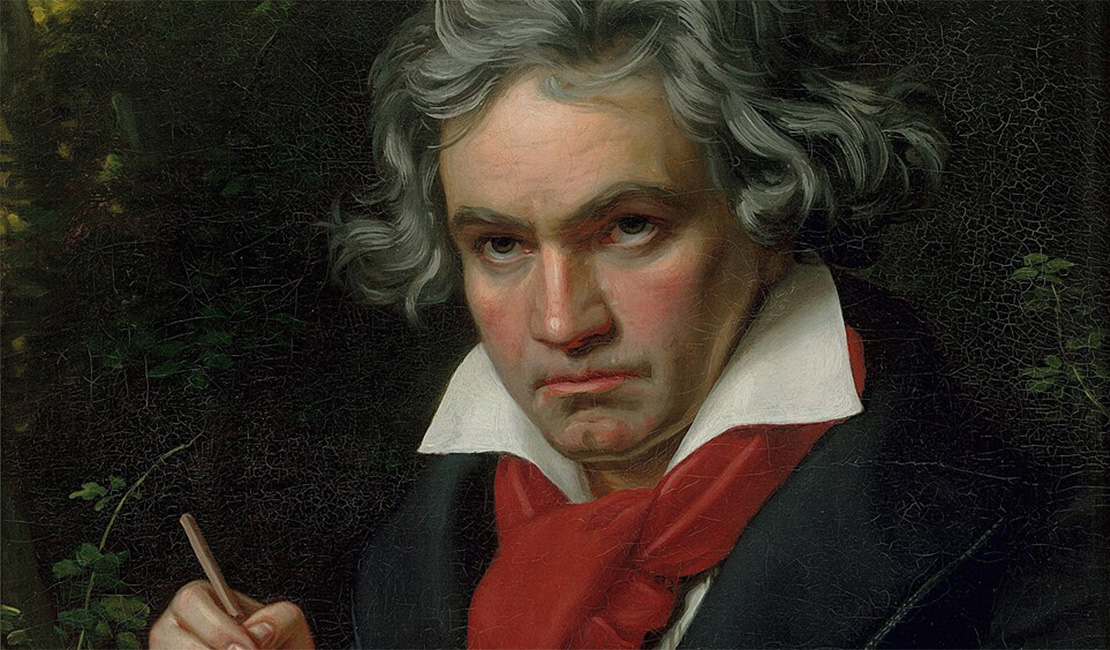
To mark the approaching 200th anniversary of Ludwig van Beethoven’s death in 2027, Wise Music Group present a selection of repertoire pairings to inspire programming ahead of the important moment.
Through their forces, inspiration or thematic content, these suggestions have been selected to bring the masters’ classics into practical yet enriching contact with new, exciting and unexpected repertoire.
Symphonies
Joan Tower – Sequoia (1981 – 16 mins)
2(2pic).2.2.2/4.2.2+btbn.1/5perc/hp.pf(cel)/str
Tower mentions the work grappling with Beethoven in the note but it's not a direct response to a particular symphony. Given Tower's brass-heavy writing, I think it could be cool to pair it with the 5th for its introduction of trombones/big brass moment at the opening of the finale.
Stephen McNeff – Heiligenstadt (2005, 14 min)
2+pic.2.2.2+cbn/4.2.3.0/timp.2perc/str
Written as a companion piece to Beethoven's Fifth, Stephen McNeff's 14 minute piece was commissioned by the Bournemouth Symphony Orchestra as a piece which would fit into a classical programme consisting of Brahms, Liszt and Beethoven.
McNeff says the work “was inspired by Beethoven's struggle to come to terms with his deafness and, although the music is not programmatic, it embodies an acceptance of human mortality alongside a refusal to be daunted by its inevitability.”
The reference to Beethoven's Heiligenstadt testament - the revelation that, in utter despair at his increasing deafness, only art had kept him from suicide - was key. For McNeff, the Fifth is about succeeding in the face of adversity, and the quotation from the song Sehnsucht (Longing) offered the contemplative starting point for an exploration of something angrier but no less profound, with the transitions from Beethoven into his own terse language artfully wrought.
Patrick Hawes – Rain (2006, 5 min)
2222/4230/3perc.hp/str
A joyous 5 minute work for instrumentation matching that of Beethoven’s Pastoral Symphony, Hawes’ Rain would make a fantastic opener, summoning the force of nature through a joyous representation of rain.
<div style="position:relative;padding-top:max(60%,326px);height:0;width:100%"><iframe allow="clipboard-write" sandbox="allow-top-navigation allow-top-navigation-by-user-activation allow-downloads allow-scripts allow-same-origin allow-popups allow-modals allow-popups-to-escape-sandbox allow-forms" allowfullscreen="true" style="position:absolute;border:none;width:100%;height:100%;left:0;right:0;top:0;bottom:0;" src="https://e.issuu.com/embed.html?d=rain_14416&u=scoresondemand"></iframe></div>
Jonathan Dove – Sunshine (2018, 5 mins)
2(II:pic).2.2.2/2.2.0.0/timp(tgl)/str
Sunshine is a short orchestral work originally written for the Bamberg Symphony Orchestra, who were looking for a piece for orchestra to perform following Tchaikovsky’s Manfred Symphony.
“I initially found it hard to imagine anything I might want to hear after that extraordinary piece, but one day a little woodwind dance started in my mind, with a singing violin line floating over the top, and I thought the combination of singing and dancing would offer a nice contrast to the high energy of many symphonic finales. It made me think of standing in a patch of sunlight, feeling warmth spread through my body, and a glow of happiness.”
– Jonathan Dove
Scored for similar forces to Beethoven’s Sixth, it would surely make a suitable and glowing encore to the Pastoral Symphony.
Britta Byström – A Walk to Beethoven (2019, 11 min)
1+pic.2.2.2/2.2.0.0/timp/str
Britta Bystrom’s Walks are always a rhythmical music which serves as an introduction to another composer’s work. The idea is to take a musical stroll, during which you can catch a glimpse of the next work on the programme, similar to when from far away, one can discern the silhouette of an approaching town.
A Walk to Beethoven was composed as an approach to Beethoven’s Symphony no. 7. The main theme of the second movement is discernable through 14 small versions (played without breaks). They become like 14 flowers grown from the same musical seed. Or maybe like 14 different paths, all leading to Beethoven.
Donnacha Dennehy – Brink (2020 – 5 mins)
A prelude to Symphony 8, Brink is Dennehy’s response to the way in which Beethoven takes ideas to the brink, with developments of an idea pushed and pushed throughout a composition.
The joyous finale of Beethoven’s irrepressible Ninth Symphony is one of the most famous melodies ever written. It’s a tune which everyone has their own unique relationship to, yet manages to connect people through its boundless energy and triumphant unifying of massed voices. For over 200 years the ‘Ode to Joy’ has engulfed us in its boundless energy, here are a few works intended to complement or accompany or complement the master work.
Helen Grime – Meditations on Joy (2019, 15 mins)
3(pic:afl).2+ca.3.2+cbn/4.3.2+btbn.1/timp.4perc/cel.hp/str
Meditations on Joy is a three-movement work inspired by different poems associated with joy. The composer describes it as “an exploration of joy in its many different forms, from a personal perspective. The act of composing, although often a huge challenge, can occasionally elicit the most intense feeling of joy, and that is something that I wanted to pervade the whole piece. This is contrasted by much darker music, the one often coming out of the other quite unexpectedly.” Meditations on Joy was commissioned by Deutsches Symphonie-Orchester Berlin, the Los Angeles Philharmonic Orchestra, Music and Artistic Director Gustavo Dudamel, and the BBC. Following delays due to Covid, it was premiered in February 2023 by the LA Phil conducted by Otto Tausk. It was paired with Beethoven’s Symphony No. 9 at its subsequent performances at the BBC Proms and with the Deutsches Symphonie-Orchester Berlin.
Tan Dun – Choral Concerto: Nine (2024, 25 mins)
Mixed Chorus; 2+afl(pic).2.2.2+cbn/4.0+2ctpt.3.0/timp.4perc/str
Tan Dun’s Choral Concerto: Nine for chorus, vocal soloists and orchestra was commissioned for the occasion of the 250th anniversary of Beethoven’s birth. The work quotes Beethoven’s Ode to Joy, and is written in three sections respectively named Nine, Wine, and Time (Ode to Peace), which juxtapose Chinese texts alongside the words of Ode to Joy by Friedrich Schiller.
“These three words, Nine, Wine and Time...in Chinese they are all ‘Jiu,’” writes Tan Dun, Nine investigates the spiritual significance of these three entities, while also drawing a connection between Beethoven and Schiller’s Ode to Joy and more ancient poetry and philosophy from the composer’s homeland.
William Barton – Ayatku Muruu (2025)
choir; 2.1.1.0/0.0.3.0/3perc/str
This work was commissioned by the Sydney Symphony Orchestra and Simone Young to be a companion piece for Beethoven 9. It will receive its premiere in November 2025, in a concert demonstrating the continued power of Beethoven's profoundly human message. A companion to this timeless symphony, Ayatku Muruu is inspired by the themes in Beethoven’s work, and will provide a fresh, contemporary and uniquely Australian perspective.
Ørjan Matre – Freude (2025 – 8 mins)
SSAATTBB (offstage) 2.2.2.2+cbn/2.2.1+atrbn+btbn.0/timp.bdr(offstage)/str
Freude, an 8-minute piece for mixed choir and orchestra, is a prelude to Beethoven’s Ninth Symphony, which followed the work in its premiere by the Bergen Philharmonic Orchestra and Bergen Philharmonic Choir in September 2025 led by Jan Willem de Vriend. Freude, (German for Joy) is Matre’s reflection on Beethoven’s continuing resonance, making it a particularly poignant work in the year of Beethoven’s anniversary.
Piano Concerto pairings
Reiner Bredemeyer - Bagatellen für B (1970 – 7 mins)
pf + 2.1.2.2/2.2.2.1/timp.perc/str(8.7.6.5.4)
This short work from Peters East German Library 1949-1990, is a very effective short piece, suitable as an overture for a Beethoven programme of any sort. The dramatic work uses aleatoric elements reflecting the eclectic compositional techniques which flooded late 20th-century Eastern Germany.
Sally Beamish - City Stanzas (2016, 23 mins)
pf + 1(pic).2.2(II:bcl).2/2.2.0.0/perc(timp)/str
This piano concerto derives all of its material, in one way or another, from Beethoven’s Piano Concerto no.1, which it was commissioned to partner by Jonathan Biss. The music is darkly sardonic, in part due to the work’s subject – the urban landscape – and its resulting political implications, yet each movement takes as its starting point a small group of notes or a rhythmic pattern from each corresponding movement in the Beethoven. All three movements are symmetrical in some sense – the first two framed by a mirror image of their opening bars, and the last a typical rondo, beginning and ending with its main theme.
Peggy Glanville-Hicks - Etruscan Concerto (16 mins)
Glanville-Hicks' Etruscan Concerto is almost certainly her best known work - instantly recognisable from the opening notes of its joyous first movement. Inspired by D.H Lawrence's collection of travel writings Etruscan Places, the music is full of memorable tunes, colourful orchestration and rhythmic energy.
The short, light, piano concerto shares a lot of similarity in melodic ideas and emotional quality with Beethoven’s second Piano Concerto, or could pair equally well with a lighter symphony like 2 or 8.
Fabrice Bollon - Beethoveniana (Concerto for solo piano and strings) (2023, 22 mins)
Written in 2023 this work for Solo Piano and strings by German composer Fabrice Bollon is well suited as a second piece after an overture. Containing Beethoven quotations, it could take centre stage of a programme instead of, or be accompanied by a Beethoven work such as his Piano Concerto 4.
Arnulf Herrmann – Manische Episode (2019 – 16 mins)
3(III:pic).2.3(I:bcl,Ebcl.II:bcl,Ebcl.III:bcl).3(III:cbn)/4.2.3.1/2timp.2perc/hp/str(10.8.6.6.4)
An orchestral depiction of mania in all its forms
- Colin Clarke Classical Explorer 2023
The head motif of Beethoven's Fifth Symphony is transcribed throughout this first movement from Herrmann’s Tour de Trance. The infamous motif does not appear anywhere as a simple motif quotation, but is always overlaid or embedded, like a message that no longer has a single originator.
As a commentary on and exercise in developing Beethoven’s own material it could of course pair well with the Fifth, or any later symphony for that matter. Alternatively, a Piano concerto could generously supplement the work in a programme pairing.
Chamber
Karen Tanaka – At the grave of Beethoven (1999, 9 mins)
String Quartet
'At the grave of Beethoven' was commissioned by the Brodsky Quartet, on the occasion of the bicentenary anniversary of Beethoven's opus 18. The title suggests admiration and a tribute towards Beethoven, and this work is based on Beethoven's string quartet opus 18 no.3.
Opus 18 no.3 is probably the most gentle and lyrical work in the set. I feel the pure spirit and ardent hope of young Beethoven in it. The first movement of 'At the grave of Beethoven' was inspired by the first four bars of opus 18 no.3. These four bars were developed and interpreted in a contemporary manner, reflecting the tension and anxiety of our life today. The second movement is made by chains of modulations. When I was writing this movement in the spring of 1999, the news from Kosovo was reported on TV every day. I was shocked and horrified by this civil war, and it influenced my writing unconsciously. Along with each modulation, I had images that lotus flowers grow and bloom, in the hope of serenity and peace.
© Karen Tanaka
George Lewis – Born Obbligato (2013 – 27 mins)
Conceived in dialogue with Beethoven’s Septet Op. 20 (1800). Beethoven scholar Nicholas Mathew, to whom the work is dedicated, pointed out to me that the Septet’s convivial affect deviates markedly from the standard image of Beethovenian fist-shaking.
Born Obbligato borrows from the Septet’s structure and texture, if not its conviviality. Both the title and musical intent of Born Obbligato derive from a remark Beethoven made in an 1800 letter to his Leipzig publisher, in which he announced “a septet per il violino, viola, violoncello, contrabass, clarinett, corno, fagotto – tutti obligati”– adding parenthetically, “I cannot write anything that is not obbligato, for I was already born with an obbligato accompaniment.”
- George Lewis