
Manuel de Falla at 150 – The Spanish Master
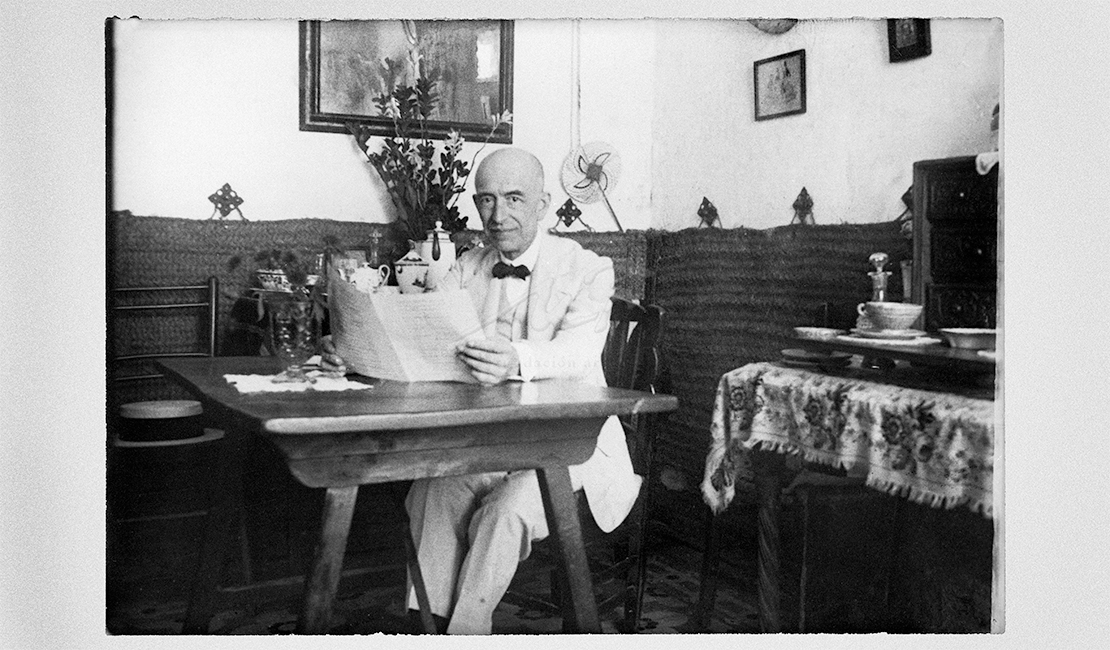
Widely regarded as the greatest Spanish composer of the twentieth century, Manuel de Falla developed an interest in native Spanish music - in particular Andalusian flamenco - while studying with Felipe Pedrell in Madrid in the late 1890s. From 1907 to 1914 he lived in Paris where he met, and was influenced by, Ravel, Debussy and Dukas. Several of his key works are very regularly performed across the globe, and in addition often choreographed in ballet and dance works.
Chester Music and Unión Musical Ediciones, part of Wise Music Group, have published the catalogue of this Spanish legend for over a century, which includes nearly sixty works in many genres. His music holds a firm place on the international music scene and has been recorded and broadcast numerous times.
Born in 1876, 2026 marks the 150th anniversary of de Falla's birth. To celebrate the landmark year Wise Music Group are proud to spotlight a selection of the composer's greatest works in this feature. Also highlighted are a selection of concerts and events throughout the year where you can hear the music performed live around the world.
Listen to Manuel de Falla on Spotify
Manuel de Falla in Dance
Manuel de Falla composed El Sombrero de Tres Picos (The Three-Cornered Hat) at the request of impresario Sergei Diaghilev for the legendary Ballets Russes. In 1916, on the company’s first tour to Spain, Stravinsky introduced Diaghilev to de Falla, describing him as “modest and withdrawn as an oyster”. He had already written incidental music for a mime entitled El Corregidor y la Molinera based on Alarcon’s novel El Sombrero de tres picos and Diaghilev asked the composer if he would extend the work into a more substantial piece. Centered around sexual jealousy, possessiveness, mistaken identity and deception, it tells the story of the failed attempts by an elderly local magistrate (whose three-cornered hat is a symbol of authority) to seduce the miller’s lovely wife. The original choreography is by Leonid Massine and sets and costumes were by Pablo Picasso. de Falla explores his full command of Spanish folklore and fluid dance rhythms in a ravishingly orchestrated score.
Diaghilev was originally interested to make a ballet on the existing piece Nights in the garden of Spain but was initially unsuccessful. Since then the work has been choreographed many times. The work is brilliantly written beautiful orchestral colours and a vividly intoxicating Spanish flavour and a clear grounding in the harmonic world of French Impressionism
El amor brujo (Love, the Magician, literally, Spell-bound Love or The Bewitched Love,) is a ballet composed in 1914–15 by Manuel de Falla to a libretto by Gregorio Martínez Sierra. The music is immediately vibrant and beautiful and contains the much-performed Ritual Fire Dance.
Key Works
El Amor brujo (Second Version) (1925) 23 mins
Mezzo soprano [or ca]; 2(pic)1(ca)21/2200/timp.perc/pf/str
Candelas, a beautiful young woman, is prevented from returning the passionate love of Carmelo, a handsome, gallant man, by the ghost of a faithless wicked gypsy whom she once loved. Carmelo persuades Lucia, a friend of Candelas, to act as decoy and distract the ghost while he convinces Candelas of his true love and they exchange the kiss that breaks the evil spell.
The Three-Cornered Hat (El Sombrero de Tres Picos) (1919) 35 mins
3(1&3=pic).2+ca.2.2/4331/timp.5perc/hp.pf(cel)/str+Mz
An honest miller is happily married to a good wife. The elderly local governor, who wears a three-cornered hat, uses his power falsely to arrest the miller and keep him away from home, so that he himself can pursue the miller’s wife. Having escaped and finding the governor in bed, the miller at first contemplates murder, but decides on a neater revenge. He swaps clothes with his persecutor and visits the governor’s wife.The governor, now in the miller’s clothes, is re-arrested. A crowd gathers, the miller reappears, is reunited with his wife and the governor is mocked.
El Corregidor y la Molinera (The Magistrate and the Miller’s wife) (1917) 43 mins
1(pic)1111/100/pf/str
Pantomime in two tableaux
The time is 19th century, the scene a mill on the outskirts of a small Andalusian town. In the first scene, the miller and his wife Frasquita are going about their daily chores outside the mill in the afternoon sunlight. A tame blackbird in a cage makes himself heard. A procession passes by – the local corregidor (town magistrate) wearing his official dress with the three-cornered hat, his wife in a sedan chair and a posse of alguaciles (police). The corregidor notes with approval Frasquita’s charms. Later, when she is dancing a fandango alone, he slips back. She teases him, holding a bunch of grapes just out of reach. He stumbles, has to be picked up and dusted down, then departs in ill-humour. The dance resumes.
In the second scene neighbours gather to celebrate St John’s Eve. As night falls the couple prepare for bed. A knock on the door signals the police, armed with a warrant for the miller’s arrest. They take him off, leaving the wife alone and frightened. Knowing that the miller will not be there the corregidor steals back again. In the darkness he falls in to the mill-race. Hearing the noise Frasquita looks out and sees the Corregidor clambering out the water, soaked to the skin. She offers him hospitality and spreads out the sodden garments to dry. The miller unexpectedly returns, having escaped his captors, sees the clothes – and the hat – suspects the worst, decides on revenge, puts on the corregidor’s clothes (leaving his own in a heap on the ground) and goes back to the town to serenade the corregidor’s wife, scrawling a message to that effect on the wall. When the corregidor, still shivering, emerges from the mill there is nothing he can do but wear the miller’s clothes. The police return, searching for the miller, and arrest their master by mistake. The wife also fails to recognise the corregidor. Fearing that they are attacking her husband, she joins the fray. When the miller reappears (still in the corregidor’s clothes), the hubbub increases. The curtain falls, abruptly, on confusion and a hail of blows.
Concerto for Harpsichord (1926) 15 mins
fl.ob.cl.vn.vc
This is a chamber concerto written for harpsichord and chamber ensemble in 1923–26. It was written for and premiered by Wanda Landowska, to whom the score is dedicated.
Falla had met Wanda Landowska on several occasions in the early 1920s, and by the time she participated in the Paris premiere of Falla's El retablo de maese Pedro in June 1923, he had already decided to write a concerto for her. Although there was never a formal commission, composition began in October 1923 but work proceeded slowly. Landowska first planned to perform the work in the 1923–24 season. When Falla found it impossible to meet that deadline, Landowska discussed with Leopold Stokowski a performance as part of the Philadelphia Orchestra's 1924–25 season, but again Falla could not finish the work in time. The premiere finally took place in Barcelona on 5 November 1926, with further performances in New York and Boston.
The Concerto was the last lengthy work Falla completed. Although there are several subsequent pieces in his catalogue that are important for their content, none of them lasts more than ten minutes, and his final, monumental project, the opera-oratorio Atlántida, on which he worked for twenty years, remained unfinished at the time of his death.
El Retablo de Maese Pedro (1922) 30 mins
Boy soprano, Tenor, Bass-baritone; 2+ca.11/2100/perc/hp.hpd/str
Text after Cervantes
The story of this Chamber Opera is taken from the second part of Don Quixote. A travelling showman arrives at the inn where Don Quixote and Sancho Panza are resting and puts on a performance with his puppet theatre, enacting the tale of the rescue of a Spanish princess from Moorish captivity by a knight from Charlemagne’s court. The narrator tells the story with such convincing involvement that during the final pursuit of the escaping couple, Don Quixote, himself, launches into the attack on the puppet pursuers, cutting them to shreds.
Nights in the Gardens of Spain (1915) 23 mins
Piano; 2+pic.2+ca.2.2/4231/timp.perc/hp.cel/str
De Falla referred to Nights in the Gardens of Spain as "symphonic impressions." The piano part is elaborate, brilliant, and eloquent but rarely dominant. The orchestral writing is lush. It is de Falla’s most "impressionistic" score. The Spanish composer Joaquín Turina called it "the most tragic and sorrowful of his works," in which is expressed "an intimate and passionate drama."
Explore the full catalogue of Manuel de Falla
2026 Concerts and events featuring de Falla's work
15th May 2026
El Amor brujo (Second Version)
New Haven Symphony Orchestra
Perry So, conductor
Adriana Zabala, Mezzo; Eva Conti, Dancer
The Estate New Haven, CT United States of America
16th May 2026
The Three-Cornered Hat (El Sombrero de Tres Picos)
Bromley Symphony Orchestra
Adrian Brown, conductor
Langley Park Centre for the performing arts, Beckenham, United Kingdom
18th May 2026
El Amor brujo: Ritual Fire Dance
Staatsorchester
Theater, Braunschweig, Germany
5th June 2026 - 7th June 2026
The Three-Cornered Hat: Three Dances from Part II
Rundfunk-Sinfonieorchester Berlin
Ana Maria Patino-Osorio, conductor
Haus des Rundfunks, Berlin, Germany
6th June 2026 - 7th June 2026
Nights in the Gardens of Spain
Orlando Philharmonic
Eric Jacobsen, conductor
Steinmetz Hall, Orlando, FL, United States of America
7th June 2026
El Amor brujo (Second Version)
Quad City Youth Symphony Orchestra
Hisham Bravo Groover, conductor
Bartlett Performing Arts Center, Moline, IL, United States of America
9th June 2026
El Amor brujo: Ritual Fire Dance
Philharmonisches Orchester Freiburg
André de Ridder, conductor
Münsterplatz, Freiburg, Germany
16th June 2026 - 11th July 2026
The Three-Cornered Hat: Scenes and Dances from Part I
The Three-Cornered Hat: Three Dances from Part II
Tonkünstler-Orchester Niederösterreich
Fabian Panisello; Luis Prades Rubias, conductors
MuTh Konzertsaal, Vienna, Austria
20th June 2026
The Three-Cornered Hat: Scenes and Dances from Part I
The Three-Cornered Hat: Three Dances from Part II
Slaithwaite Philharmonic Orchestra
Benjamin Ellin, conductor
Huddersfield Town Hall, Huddersfield, United Kingdom
28th June 2026
The Three-Cornered Hat: Three Dances from Part II
Musikkollegium Winterthur
Roberto Gonzales-Monjas, conductor
Stadthaus, Winterthur, Switzerland
4th July 2026
The Three-Cornered Hat (El Sombrero de Tres Picos)
New Tyneside Orchestra
Nick Nowicki, conductor
St Gabriel's Church Heaton, Newcastle, United Kingdom
11th July 2026
The Three-Cornered Hat: Scenes and Dances from Part I
The Three-Cornered Hat: Three Dances from Part II
Tonkünstler-Orchester Niederösterreich
Fabian Panisello; Luis Prades Rubias, conductors
Wolkenturm, Grafenegg, Austria
13th July 2026 - 15th July 2026
El Amor brujo: Ritual Fire Dance
Hochschulorchester Paderborn
Steffen Schiel, conductor
Audimax Universität, Paderborn, Germany
19th July 2026
Rafael Aguirre, guitar
Spanish National Orchestra
David Afkham, conductor
Royal Albert Hall, London, UK
1st October 2026 - 3rd October 2026
El Amor brujo (Second Version)
Maria Toledo
Toronto Symphony Orchestra
Gustavo Gimeno, conductor
Roy Thomson Hall, Toronto, ON, Canada
2nd October 2026 - 3rd October 2026
The Three-Cornered Hat (El Sombrero de Tres Picos)
Annapolis Symphony Orchestra
Jose-Luis Novo, conductor
Maryland Hall, Annapolis, MD, United States of America
8th November 2026
Nights in the Gardens of Spain (chamber orchestra)
Orlay Alonso
Worthington Chamber Orchestra
Antoine T. Clark, conductor
Worthington United Methodist Church, Columbus, OH, United States of America
10th March 2027 - 14th March 2027
El Amor Brujo (Love, the Magician)
Marina Abramović / Gustavo Dudamel
Pasión Vega, mezzo
New York Philharmonic Orchestra
Gustavo Dudamel, conductor
Wu Tsai Theater, David Geffen Hall, New York, United States of America
15th April 2027 - 16th April 2027
El Amor brujo (Second Version)
Atlantic Classical Orchestra
David Amado, conductor
Lyric Theatre, Stuart, FL, United States of America
(May 2026)