
Just Our Lonely Selves: Morton Feldman at 100
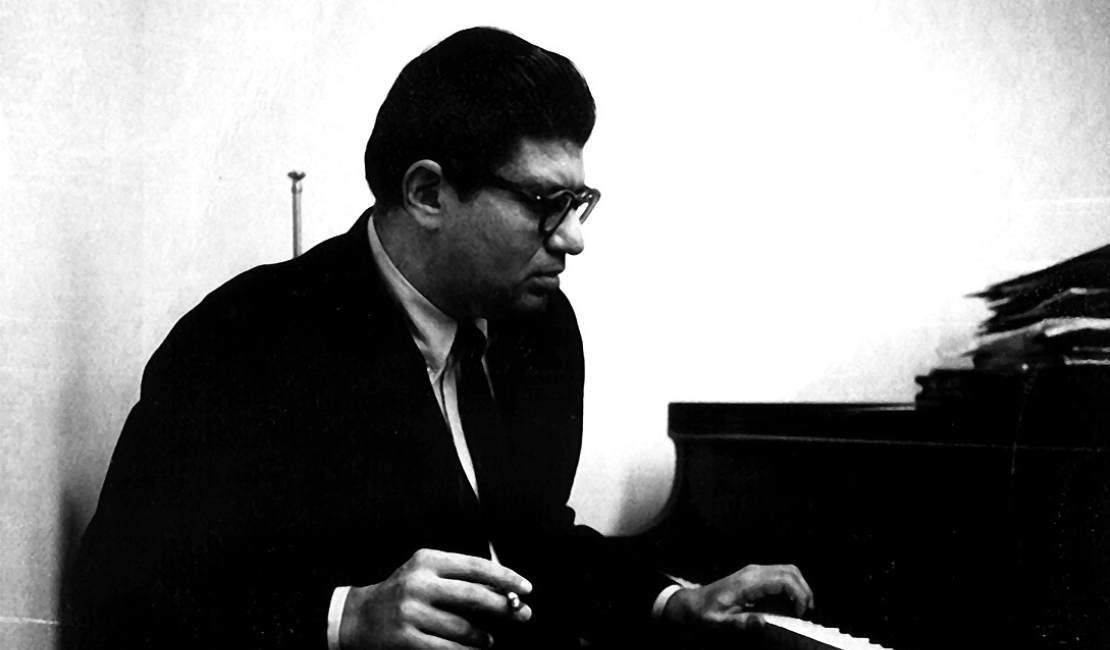
Composer Morton Feldman (1926-1987) was one of the great artists of the 20th century, achieving remarkable innovations of notation, style, collaboration, and musical philosophy. Feldman’s aesthetic is sensual, subtle, and distinctly his own. Alex Ross calls him a “lonely giant of American music,” whose music is composed of “all-pervasive quiet, slow and irregular pulses, mercurial shifts of ambiguous harmony, wanly beautiful instrumental colors, [and] slivers of truncated melody.”
Along with the composers John Cage, Christian Wolff, Earle Brown, and David Tudor, Feldman made up the core of a musical community known as the New York School, who worked in close dialogue with visual artists Mark Rothko, Philip Guston, Jackson Pollock, Robert Rauschenberg, Willem and Elaine de Kooning, dancers Merce Cunningham, Merle Marsicano, and writers Frank O’Hara, John Ashbery, Kenneth Koch, James Schuyler, and Barbara Guest.
His remarkable catalog of music is divided across Edition Peters and Universal Edition, with Peters publishing the majority of his works from the 1950s and ‘60s. These early pieces are key to understanding Feldman’s musical ethos and the breadth of his creativity. In the composer’s own words:
When one begins to work...there is no separation between what you do and what you are […] You work. The work leads to a concept of music that draws attention. Maybe not for the right reason—but you find yourself in the world.
Yet there was that other “world”—of conversation—of anonymity—of seeing the paintings in the intimacy of the studio and not in a museum—of playing a new work on the piano in your home and not in the concert hall—of the hours spent walking, eating, and talking with John Cage and not wondering if I should fly to Paris from London in order to spend a few hours with him in arrogant crowds of people.
Innovations in graph notation and open parameters were deeply affected by his close relationship with John Cage, but his music stands alone as painterly, seductive, and even hedonistic. Feldman mainly eschewed systems in favor of finely-tuned sonic instincts based on what he called “a vibrant musicality.” His writing is full of insight and contradictions, and his dedication to music coexisted with twenty years of work in his family’s coat factory near New York City’s LaGuardia Airport. He was at all times deeply himself.
The distinctiveness of Feldman’s music offers unique opportunities to draw unexpected sonic connections with standard concert repertoire. Setting Feldman’s music next to Brahms or Barber can reveal its latent melodicism. Pairing Feldman with Varèse, or Ives—both of whom Feldman deeply respected—can sketch a multi-faceted portrait of iconoclasm. Feldman’s “partial kinship” to minimalism (for which, in Alex Ross’ words, he “served as an intermittently benevolent uncle”) can be drawn out in programs that include John Adams, Philip Glass, or Terry Riley.
Feldman’s gorgeous treatments of wordless voices and his shimmering orchestral textures beg to be showcased alongside Kaija Saariaho or Maurice Ravel. Contrasting Feldman with more rhythmically active works—even those of his bêtes noires Boulez, Schoenberg, and Stravinsky—can yield satisfying contours of movement and repose. Shared space with Cage, Wolff, and Brown will of course highlight the innovations of an important musical community. And, to precede a Bruckner or Mahler Symphony with a work by Morton Feldman is to posit how some music creates an entire universe, marked by suspended time, kaleidoscopic emotion, and spiritual ecstasy.
Christian Wolff once remarked that eventually everything becomes melody. This is true. —Morton Feldman
In honor of the 100th anniversary of his birth, Wise Music is pleased to present a selection of Morton Feldman’s remarkable works from the Edition Peters catalog.
__________
Orchestral Works
What was great about the ’50s is that for one brief moment—maybe, say, six weeks—nobody understood art. That’s why it all happened. —Morton Feldman
Intersection I (1951)
Intersection I is Feldman’s first graph piece for orchestra, and among his earliest graphic works for any forces. Dividing the orchestra into winds, brass, upper strings, and lower strings, Feldman’s score maintains the core framework of traditional Western notation but lays aside many of its other symbolic trappings.
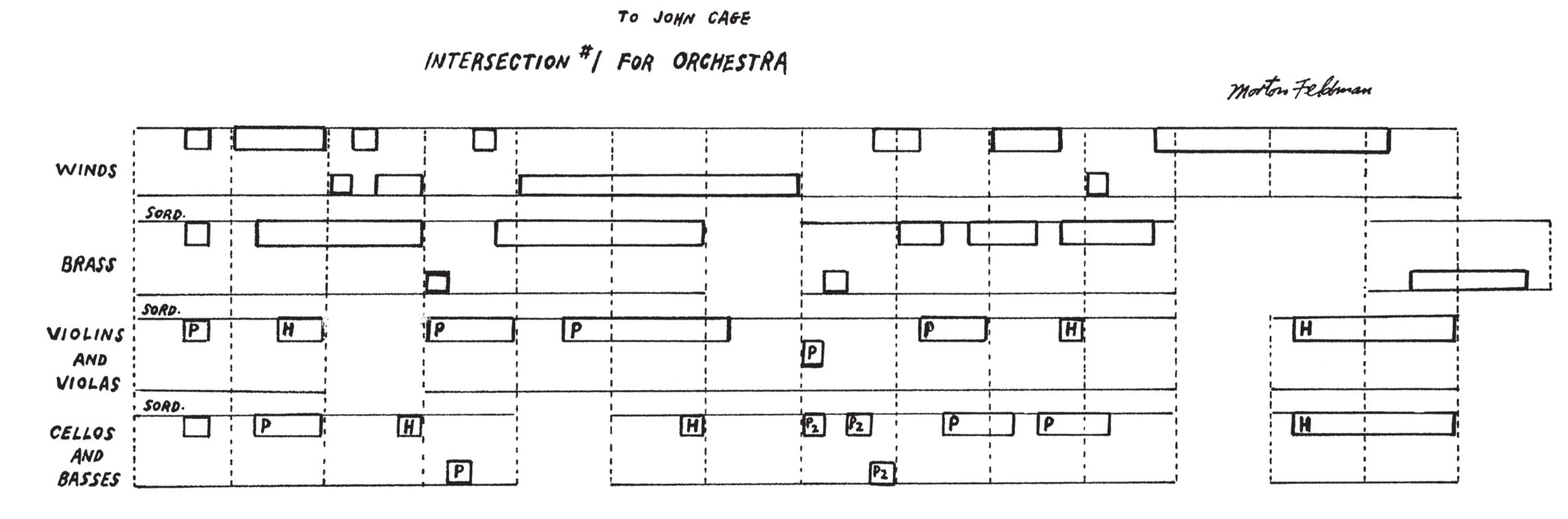
Opening of Intersection I
As one might imagine, John Cage read Feldman’s notational choices through the lens of his own philosophy of acceptance and was delighted with it:
High, middle, low; enter any time within the duration notated; this particular timbre. These are the somethings Feldman has chosen. They give him and his work character. It is quite useless in this situation for anyone to say Feldman’s work is good or not good. Because we are in the direct situation: it is. If you don’t like it you may choose to avoid it. But if you avoid that’s a pity, because it resembles life very closely, and life and it are essentially a cause for joy.
Intersection I seems not to have been performed in the years immediately following its composition and, the recent premiere orchestral recording by Brad Lubman and the Deutsches Symphonie-Orchester Berlin is indeed a cause for joy. (Composer Samuel Clay Birmaher also details his thoughtful translation of Feldman’s graph score into traditionally-notated parts for the recording in an excellent blog post.)
Sample Programs
Infernal Noise, Infernal Quiet:
Charles Ives, The Unanswered Question (5’)
Morton Feldman, Intersection I (14’)
Dmitri Shostakovich, Symphony No. 4 (1°4”)
Minimalism (A Maximalist Conception)
Morton Feldman, Intersection I (14’)
Philip Glass, Symphony No. 13 (20’)
Terry Riley, In C (variable length, ca. 45’)
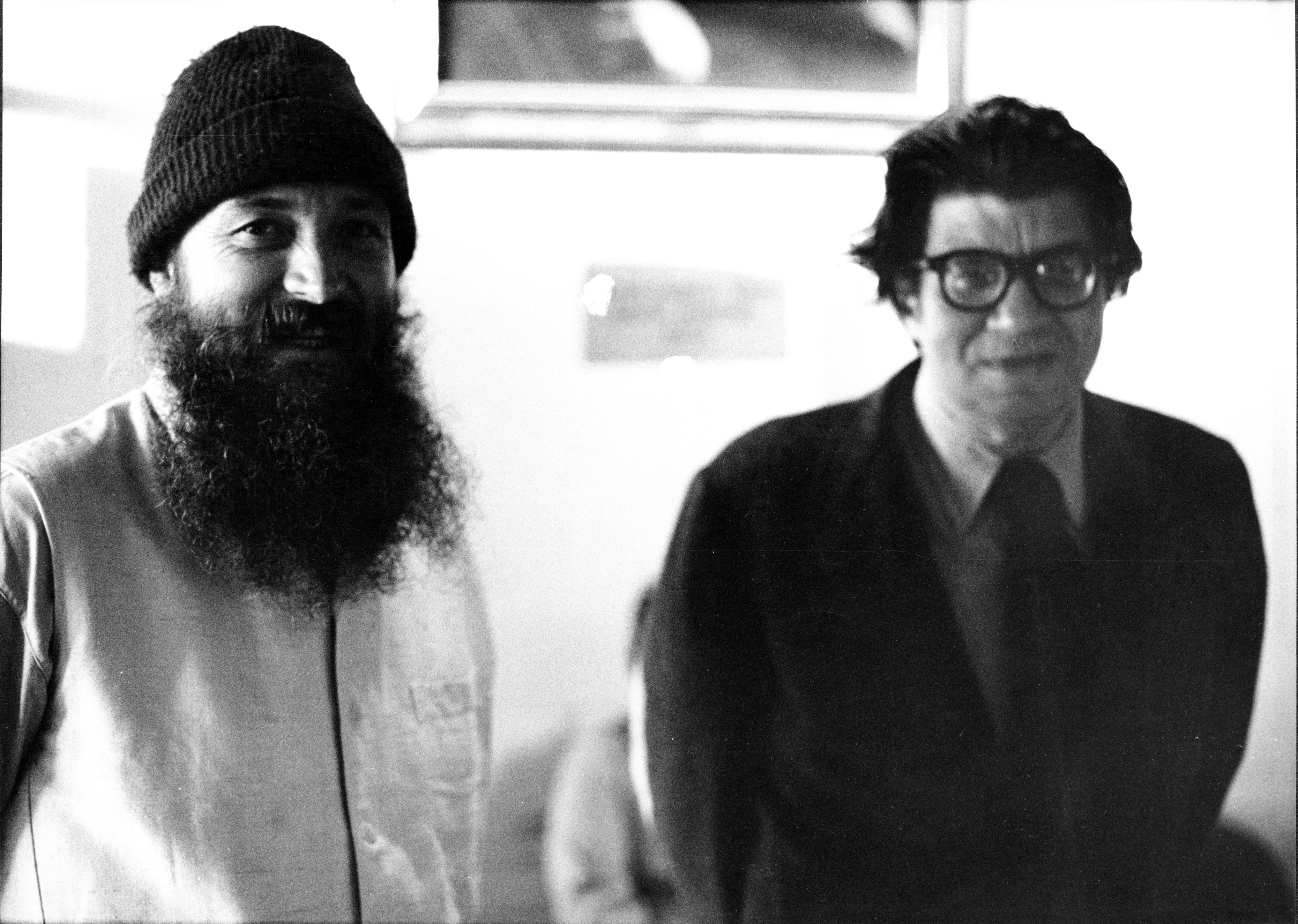
Photograph by Irene Haupt; Morton Feldman Photographs, Music Library, University at Buffalo, The State University of New York. Photograph by Irene Haupt.
__________
Structures For orchestra (1960-62)
Filled with “dream-like chordal sequences” (The Guardian), Structures is part of Feldman’s gradual return to more standard notation in the early 1960s. He describes the compositional process thus:“In various works of mine, such as The Swallows of Salangan, all the pitches are given but the performer chooses his own duration (slow) for each sound. What I did in Structures for Orchestra (1960-62) was to ‘fix’ (precisely notate) what might occur if the work utilized indeterminate elements.” Readily performable and under eight minutes, the piece is among Feldman’s most accessible orchestral works. Its quiet, timbral-rich texture would be beautiful paired with Webern’s Five Pieces for Orchestra; Feldman wryly called himself and Cage “the illegitimate sons of Webern.”
Sample Programs
American Iconoclasts
Morton Feldman, Structures for Orchestra (8’)
Henry Cowell, Variations for Orchestra (19’) or John Cage, Quartet I (10’)
Charles Ives (orch. Henry Brant), Concord Symphony (50’)
Chromatic Structures
Morton Feldman, Structures for Orchestra (8’)
Richard Wagner, Prelude und Liebestod from Tristan und Isolde (19’)
Richard Strauss, Parergon, Op. 73 (22’)
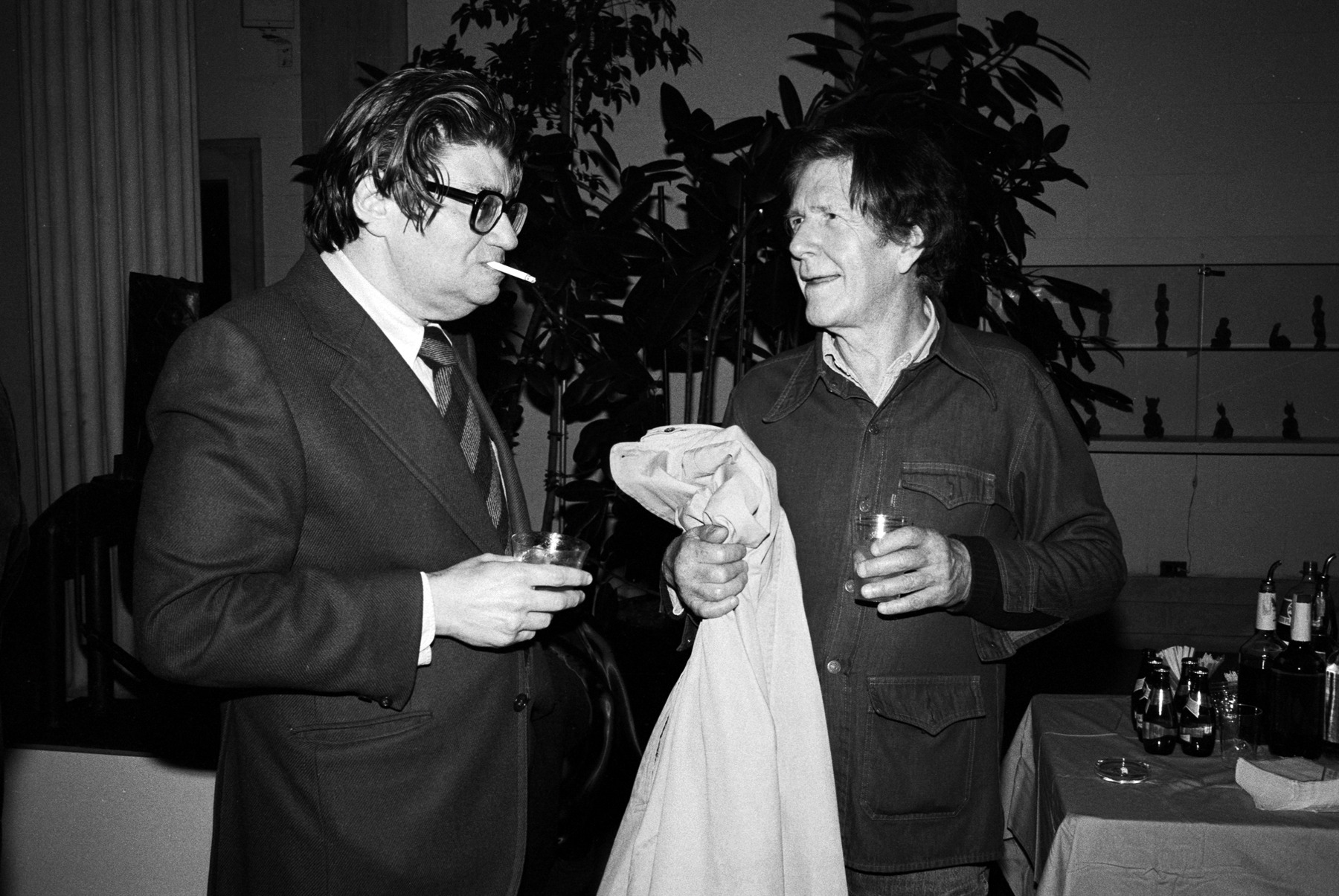
Photograph by Irene Haupt; Morton Feldman Photographs, Music Library, University at Buffalo, The State University of New York. Photograph by Irene Haupt.
__________
The Swallows of Salangan (1960)
Conductor John McCaughey writes that The Swallows of Salangan “has taken on a legendary status as a famous rarity—a work of quite unusual scope and effect, frequently referred to by Feldman himself, but barely known as a concert experience.” Its unique scoring combines choir with an ensemble of five flutes, seven cellos, five trumpets, two tubas, two pianos, and two vibraphones, recalling the off-kilter sections of like instruments of Ixion. Swallows is both adventurous and beautiful, and as McCaughey observes, it “has remarkable power to cast revelatory light” on Feldman’s artistic concerns.
One thing [is] certain. I must move, move. I must act regardless the action. Live regardless the living.
—Morton Feldman
Though the choral writing is wordless, the piece draws its title from an expansive line by Boris Pasternak: “We, like Salangan swallows, built the world—an enormous nest, put together from the earth and sky, life and death, and two times, the ready to hand and the defaulting […].”In Feldman’s score, a series of 61 chords prescribes notes for all the instrumentalists and singers, but each performer chooses their own durations; after beginning together, the ensemble (which is instructed to play softly and with a minimum of attack) slowly drifts apart to a varying degree in each performance. Though the sounding surface is quite different, the effect is reminiscent of Terry Riley’s seminal In C, written just four years after The Swallows of Salangan.
Sample Programs
Songs without Words
Kaija Saariaho, Oltra Mar (16’)
Morton Feldman, The Swallows of Salangan (variable length, ca. 8’)
Maurice Ravel, Daphnis et Chloe (50’)
Cosmos and Creation
Morton Feldman, The Swallows of Salangan (variable length, ca. 8’)
Alexander Scriabin, Poem of Ecstasy (22’)
Anna Thorvaldsdottir, Metacosmos (14’)
Arvo Pärt, Berliner Messe (22’)
__________
Chamber and Solo Works
If I want my music to demonstrate anything, it is that nature and human nature are one. —Morton Feldman
Intersection III (1953)
Scored for solo piano, Feldman’s Intersections II and III were both written for the pianist-composer David Tudor. Tudor’s importance to Feldman can hardly be overstated. Like Cage, Tudor’s support gave Feldman the permission he needed to experiment and follow his sonic instincts. As Feldman wrote to Tudor in 1953:
I realized for the fiftieth time this year how much I have taken your friendship and desperately (yes desperately) needed devotion to my work. Hardly a day passes when I don’t think of you in either some connection to my work which you helped me make permissible for me to do, or the humanness of just our lonely selves.
In Intersection III, Tudor’s musical collaboration seems to have enabled Feldman to reach for a new musical language centered on a more disjunct, almost agitated gestural vocabulary than that Feldman had employed prior. Indeed, Feldman wrote to Tudor that he was striving for “a music like violently boiling water in some monstrous kettle.”
__________
Three Pieces for String Quartet (1956)
Though Three Pieces for String Quartet is in fact traditionally notated, I Care if You Listen aptly notes that it “evokes [Feldman’s] indeterminate graphic period,” having a “languid quality and rarefied texture even for Feldman.” Compared to the massive scale of Feldman’s infamous String Quartet No. 2, the 14 minutes of Three Pieces is a model of concision that creates a delicate yet intensely affective experience.
__________
The O’Hara Songs (1962)
The poet, writer, and art critic Frank O’Hara was in so many ways the heart of the New York School. In a memorial essay for O'Hara after his tragic death on Fire Island, Feldman wrote:
His intense involvement with so many different levels of work, so many different kinds of artists, naturally created great demands on his personal loyalties. But it was part of O’Hara’s genius to be oblivious to these demands, to treat the whole thing as if it were some big, frantic, glamorous movie set. To us he seemed to dance from canvas to canvas, from party to party, from poem to poem—a Fred Astaire with the whole art community as his Ginger Rogers.
From their very first meeting in the early 50s, O’Hara admired Feldman’s “subtle authority”—his instinctive musical language free from the “posings” of more systematic approaches. O’Hara both brought Feldman into his circle of artists and poets and helped shape the reception of Feldman’s music through writing liner notes and other critical materials on his work. After sporadic sketches for an opera in the early ‘50s, the two finally came together artistically in 1962’s The O’Hara Songs, in which Feldman set the text of O’Hara’s poem “Wind” for a chamber ensemble of bass-baritone, chimes, piano, violin, viola, and cello. The first and third movements use the poem’s complete text, while the middle movement repeat the lines “Who’d have thought/that snow falls.”
To perform Feldman’s graph pieces at all, the musician must reach the metaphysical place where each can occur, allying necessity with unpredictability. —Frank O’Hara
The set is one of Feldman’s few vocal works that feature a text, and O’Hara was clearly pleased with the result; he wrote to Feldman after the completion of the songs: “I am very happy to be set by you […].”The influence of Webern is clearer than ever in these songs, with a beautiful sense of intimacy and decay.
__________
If you don't have a friend who's a painter, you're in trouble. —Morton Feldman
Feldman chose this work as one of the very first to be published when his contract with Edition Peters began. Together with John Cage, the painter Philip Guston was Morton Feldman’s most important confidante and artistic influence. Feldman describes the trio with characteristic humor and poetry:
It is significant that in all these years, Philip Guston and John Cage are equally important to me […] the basic difference between Cage and Guston [is that] Cage sees the effect, he ignores its cause. Guston, obsessed solely with his own causality, destroys its effect. They are both right, of course, and so am I. We complement each other beautifully. Cage is deaf, I am dumb, Guston is blind.
Though Feldman and Guston eventually distanced from each other around 1970, when Guston had turned away from pure abstraction towards more figurative work, Guston’s work in the 1950s and ‘60s had a deep effect on Feldman’s music and artistic thinking—especially in terms of texture, attack (or its absence), and the terms of engagement with historical tradition. Appropriately, then, this solo piano miniature has “a translucent clarity and la[ys] out its ideas with an evenness that [is] comparable to the all-over paintings of the Abstract Expressionists” (The New York Times).
__________
Ixion (1958)
Feldman wrote Ixion for Merce Cunningham’s dance piece Summerspace. Like the Intersections series, it uses graph notation, and it is scored for an unusual large ensemble of three to seven cellos, two to four basses, three flutes, clarinet, trumpet, horn, trombone, and piano. Characteristically for Cunningham collaborations, Feldman worked without knowledge of either Cunningham’s choreography or Robert Rauschenberg’s costumes and lighting.
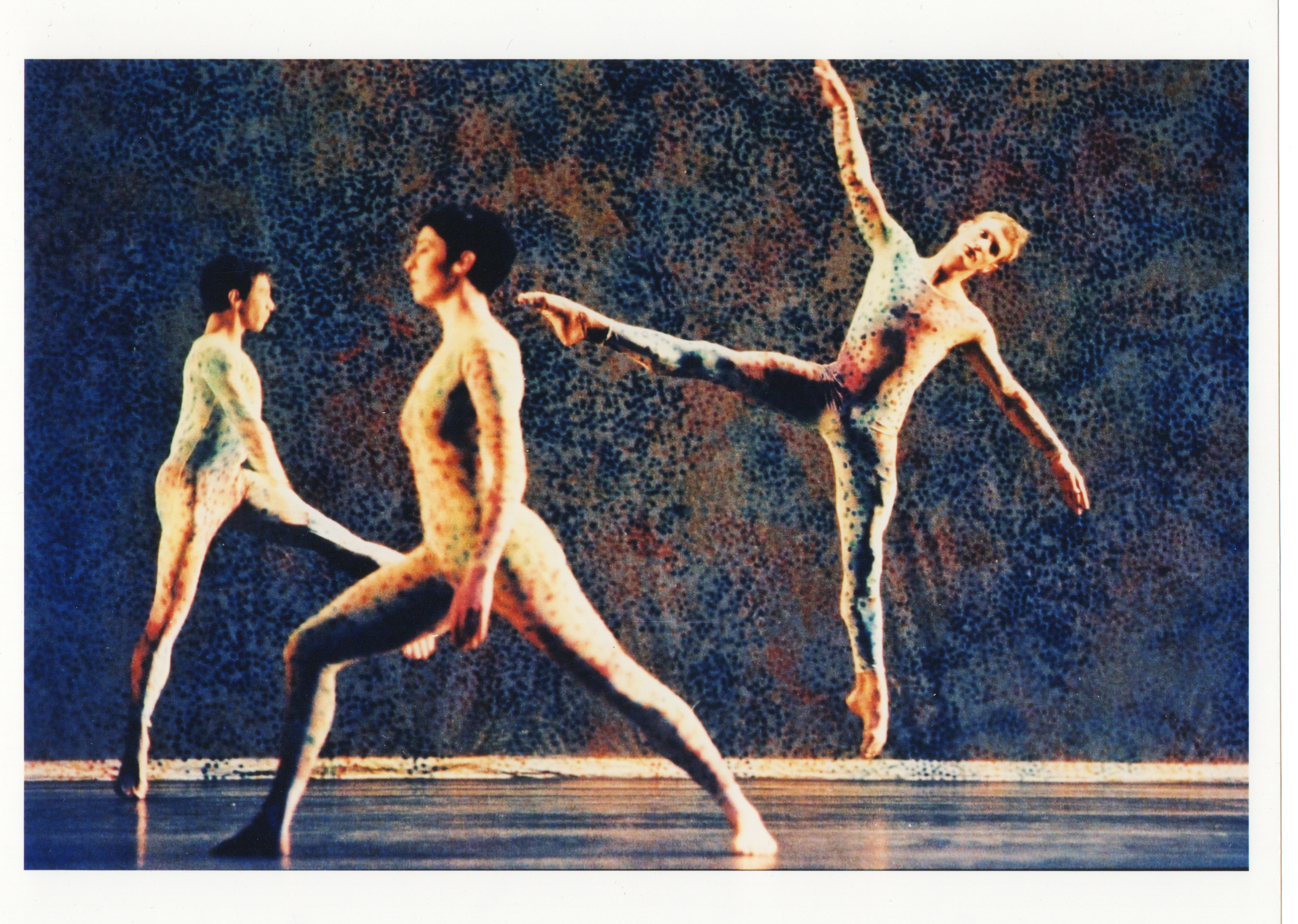
Ashley Chen, Cheryl Therrien, and Daniel Squire of the Merce Cunningham Dance Company in Summerspace (1958). Photograph by Ed Chappell, 2000. Courtesy of the Merce Cunningham Trust and the Jerome Robbins Dance Division, The New York Public Library.
As the Merce Cunningham Trust observes, Feldman’s “delicate music at times sounds like bubbles of water rising to the surface, and at others, with a muffled rumble in the bass, like distant thunder […] together, the movement, music and décor give the effect of a balmy, summer day.” After an unassuming start to life, the piece gradually became popular with audiences; The New York Times calls it “one Cunningham’s most celebrated, even classic, dances.” For Feldman, Ixion/Summerspace also marked several important developments in his artistic life, as he both met his long-term patron Dominique de Menil following a performance of the dance and, via Cunningham, began a similarly long-lasting collaborative relationship with dancer/choreographer Merle Marsicano. (Feldman went on to write three scores for Marsicano, and Marsicano also danced to a number of Feldman works not originally written for her, such as Christian Wolff in Cambridge and Chorus and Instruments II.)
Music’s tragedy is that it begins with perfection. —Morton Feldman
__________
Sources and Resources
Cadieu, Martine. “Morton Feldman—Waiting,” in Morton Feldman Says: Selected Interviews and Lectures 1964-1987, ed. Chris Villars (London: Hyphen Press, 2006).
Cage, John. “Lecture on Something,” in Silence: Lectures and Writings (Middleton, CT: Wesleyan University Press, 1961).
Feldman, Morton. Give My Regards to Eighth Street: Collected Writings of Morton Feldman (Cambridge, MA: Exact Change, 2000).
David Tudor Papers, Getty Research Institute, Los Angeles, California.
Dohoney, Ryan. Morton Feldman: Friendship and Mourning in the New York Avant-Garde (New York, NY: Bloomsbury Academic, 2022).
McCaughey, John. Liner notes for John McCaughey and Astra Choir, “We Like Salangan Swallows”: A Choral Gallery of Morton Feldman and Contemporaries, New World Records, 2018.
Morton Feldman Collection, Paul Sacher Foundation.
“Summerspace,” Merce Cunningham Trust, https://www.mercecunningham.org/the-work/choreography/summerspace/.
Pasternak, Boris. Safe Conduct (New York, NY: Signet, 1959). (The line from which Feldman’s title for The Swallows of Salangan is drawn appears on pg. 81.)
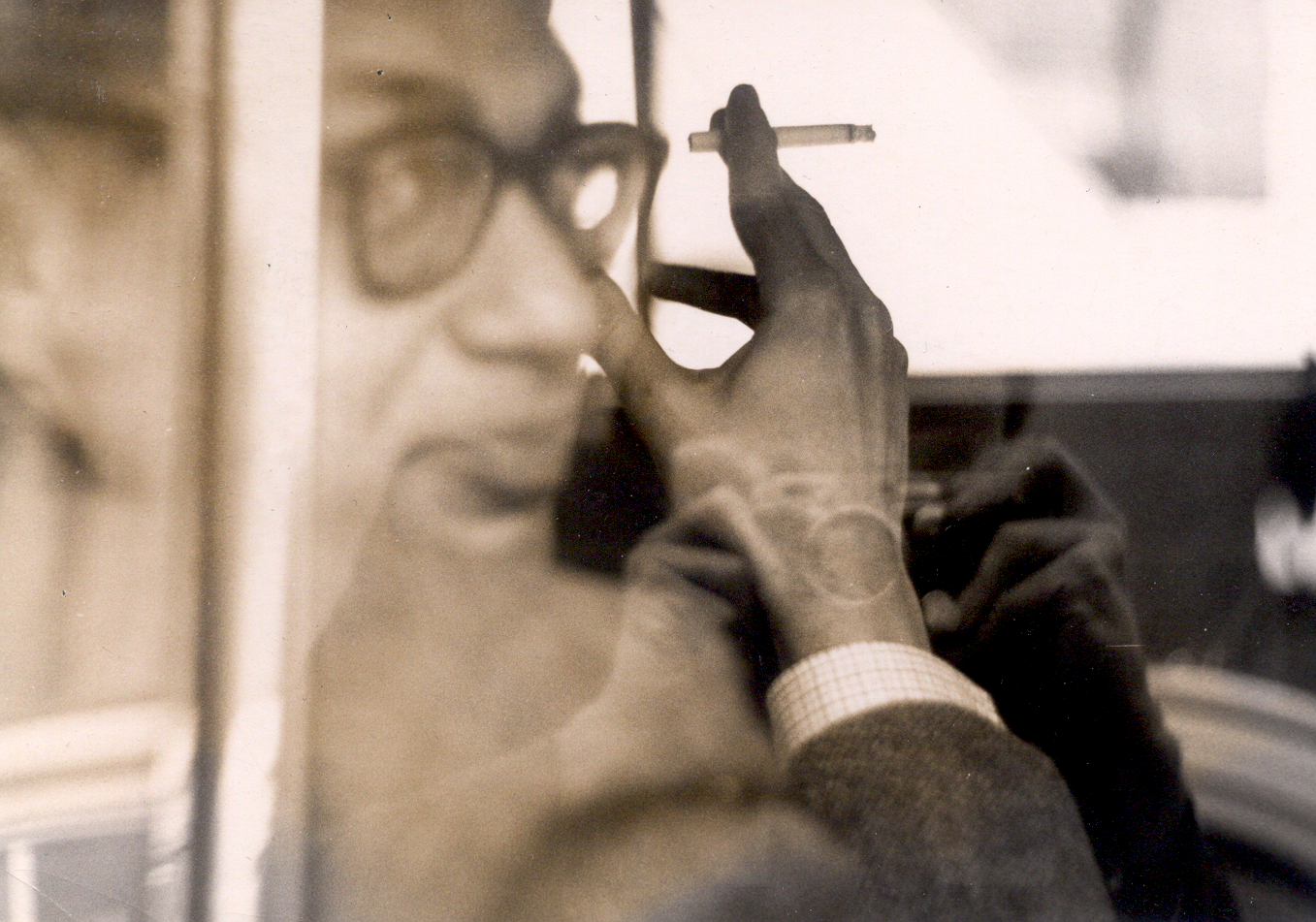
Morton Feldman Photographs, Music Library, University at Buffalo, The State University of New York.