
 Located in the UK
 Located in the USA
 Located in Europe
- Esa-Pekka Salonen
Horn Concerto (2025)
- Chester Music Ltd (World)
Commissioned by Lucerne Festival, Finnland-Institut and Berliner Festspiele / Musikfest Berlin, Elbphilharmonie Hamburg, Boston Symphony Orchestra, Hong Kong Philharmonic Orchestra and Fondazione Teatro alla Scala.
Commissioner exclusivity applies
Unavailable for performance.
- hn + 2(2pic).2(II:ca).2(II:bcl).2(II:cbn)/2.2.0.0/timp.2perc/hp/str
- Horn
- 25 min
- 1st April 2026, Cité de la Musique, Paris, France
- 2nd April 2026, Cité de la Musique, Paris, France
Programme Note
The horn was my first love in the world of music. I was learning the trumpet when I was ten but was persuaded to change to the horn by a schoolmate a couple of classes above me. He mentioned the famous quote by Schumann: The sound of the horn is the soul of the orchestra. I didn’t have much of an idea of who Schumann was, but then my friend came up with an even stronger argument: if I made it to Orchestra A in my school (there were three levels), I could skip PE lessons for rehearsals. At that point I started to get seriously interested.
My school, the Helsinki Finnish Coeducational School, had access to the top teachers in Finland, and I started my studies with Holger Fransman, the dean of Finnish horn players. He had studied in Vienna with Karl Stiegler in the late ‘20s; his fellow student and roommate was Gottfried von Freiberg, who would later become the principal horn of the Vienna Philharmonic and give the World Premiere of Richard Strauss’s Second Horn Concerto. In 1937, Holger was appointed by Robert Kajanus as the Helsinki Philharmonic Orchestra’s first Finnish-born Principal Horn.
It is not an exaggeration to say that meeting Holger Fransman changed my life. Suddenly I had a direction and an authority to guide me along the path. After my first year as his student, I understood that music was the only thing I wanted to pursue as a profession and career.
Many of my early attempts at composing were horn pieces. My first published work was Horn Music 1, which was also the score I showed to Einojuhani Rautavaara when I asked to become his student.
The idea of writing a Horn Concerto has been in my mind since those distant days. As is mostly the case, to make a project like that happen a confluence is needed: the right time and the right people. When Michael Haefliger of the Lucerne Festival got in touch in 2021 and asked if I could write a concerto for Stefan Dohr, I knew that this was the moment I had been waiting for. I have long admired Stefan’s artistry both from the podium and in the audience, and I knew that his track record performing and commissioning new works for the instrument was second to none.
The actual composition process took eighteen months, but some of the sketches are much older material, ideas that finally found a home in this project.
Memories of the famous horn moments in the repertoire seemed to repeatedly invade my imagination. I first tried to resist, but ultimately decided to embrace them and use them as material. In some cases, I embedded a well-known piece into my own harmonic world, such as Mozart’s Second Horn Concerto in the first movement, or the opening solo of Bruckner’s Fourth Symphony in the second movement. In the finished Concerto, those moments appear and disappear like fish coming to the surface to catch an insect before diving to the depths of the sea again: fleeting moments, almost too short to register.
The first movement starts with a motif, or theme (or Leitmotiv as in Wagner), that appears several times throughout the piece, here played on natural horn (not using the valves) against a synthetic overtone harmony. After a short interlude of descending string texture, a recitativo section begins: the solo horn in dialogue with the wind instruments. After a short moment of the soloist simultaneously playing and singing the Leitmotiv, an accelerando section leads to faster music: my homage to Mozart (and his friend, horn player Ignaz Leutgeb, without whom the horn repertoire would be so much poorer). The music calms down gradually. At the end of the movement the theme is heard again, this time played by the piccolo and the English Horn.
The second movement is essentially an Adagio; slowly singing music that oscillates between calm and more agitated phases. The initial solo horn monologue against a heavily pulsing string accompaniment metamorphoses into a distant memory of the famous solo in the opening of Bruckner’s Fourth Symphony. (That was the symphony I conducted in my diploma concert at the ripe age of 21). The long horn line is interrupted by two suddenly more dramatic orchestra interludes before the movement ends with echoes of the Leitmotiv.
The third movement opens with music that is related to the end section of the first movement, this time a mirror image: a gradual process from calm to playful, sometimes feverish activity.
A scherzando orchestra interlude in 12/8 meter leads to the main material of the movement, virtuosic horn solos accompanied by string rhythms from the previous interlude. The harmony is partly based on the “mystic chord” used by Scriabin in Prometheus. The motif/theme returns against slowly microtonally sinking strings.
A playful solo section follows, where the unique hand-stopping technique of the horn is used to produce rapid changes of the tone colour.
The 12/8 music returns: this time the solo horn forms a trio with the orchestra horns. Flashbacks of Eroica. The Leitmotiv is heard again, played by tutti orchestra.
The hand-stopping music returns with more active orchestra texture. A new, singing theme is introduced.
Another orchestra interlude, accelerando to a very fast tempo.
Finally: a virtuosic coda where the horn is pushed to the very limits of what is physically possible. Somehow, when writing the final minutes of the concerto, I was taken straight back to my childhood and teen years. Very powerful nostalgia, but not of the sad kind: more like a pleasant dream.
Esa-Pekka Salonen
Scores
More Info
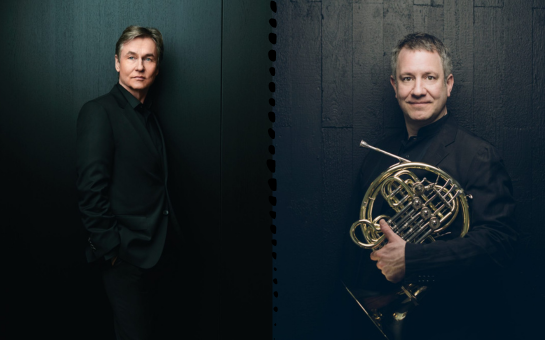
- Boston Symphony gives US Premiere of Salonen Horn Concerto
- 10th February 2026
- On February 12-14, the Boston Symphony Orchestra presents the US premiere of Esa-Pekka Salonen’s Horn Concerto, conducted by the composer and featuring soloist Stefan Dohr.
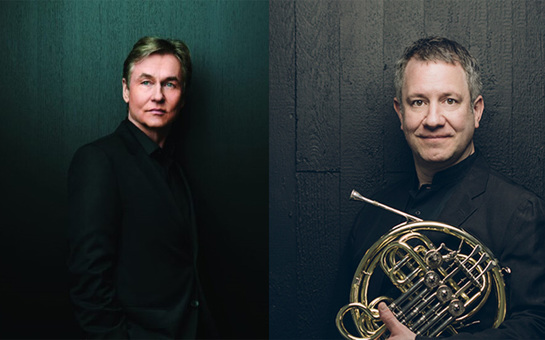
- Salonen's Horn Concerto and Swedish residency
- 20th August 2025
- Esa-Pekka Salonen will conduct the world premiere of his own Horn Concerto this summer, before embarking on an artist residency with the Swedish Radio Symphony Orchestra for 2025/26.