
Celebrating 80 years of Indian independence
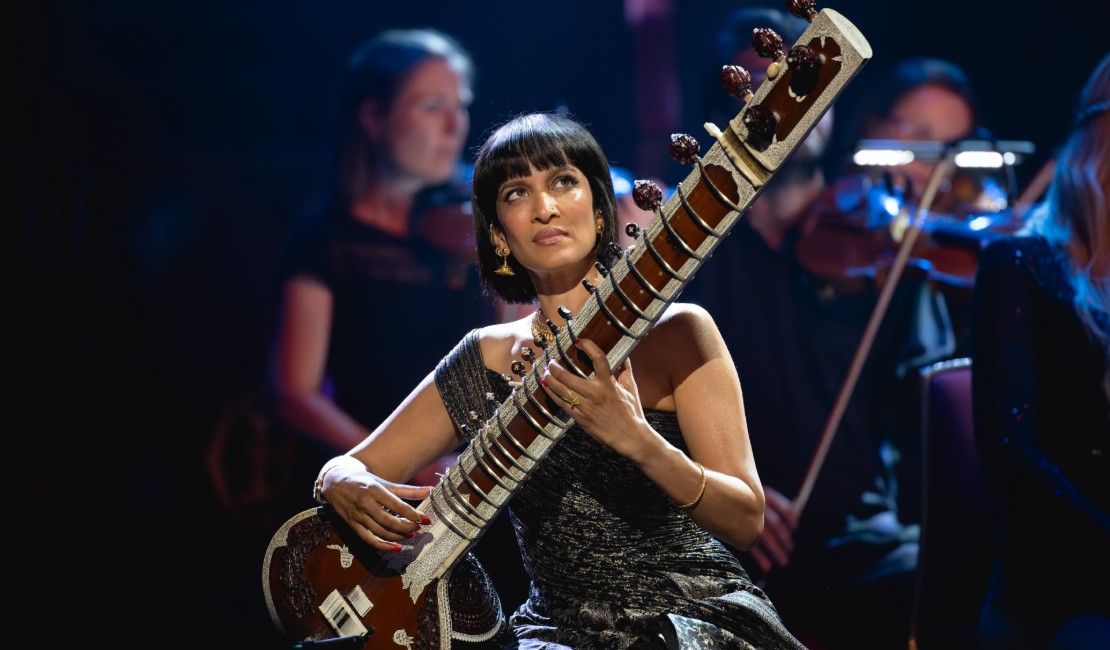
In August 1947 the Indian Independence Act was passed, allowing India freedom from British rule after almost 200 years. Celebrating 80 years of Indian independence in 2027, Wise Music have been re-exploring the works and composers hailing from and influenced by India and its culture.
The vibrancy and variety of India’s sights and sounds are undeniable – the country brims with such music, heat, noise, colour, and spirituality that to those encountering it for the first time it can be both arresting and life-affirming. It is no wonder then that so many composers have been inspired by India’s culture and soundscapes.
Ravi Shankar (1920-2012)
“Music transcends all languages and barriers, and is the most beautiful communicative skill one can have”
– Ravi Shankar
The legendary sitarist and composer Ravi Shankar was India's most esteemed musical ambassador and a singular phenomenon in the classical music worlds of east and west. As a performer, composer, teacher and writer, Shankar has done more for Indian music than any other musician. Hailed by ex-Beatle George Harrison as "the Godfather of World Music", Shankar's majestic ragas and virtuoso technique communicate a spiritual essence that continues to captivate audiences around the world. Works for the concert hall include works written for himself to perform Concerto for Sitar (1970), Concerto for Sitar No.2 (1982) and Concerto for Sitar No.3 (2009) for his daughter Anouska. All written over the course of some 30 years.
Yet a work deserving of greater attention is Symphony (2010), premiered in London two years before Shankhar’s death in 2012. Described at the time as a ‘strange hybrid between a symphony and concerto’ (Simon Broughton, Songlines), it’s a charming fusion of Eastern and Western traditions.
Symphony (2010)
2(pic).2(ca).2+bcl.2+cbn/4.3.3.1/timp.4perc/hp.[sitar]/str
43 minutes
Shankar's first symphony conceived for a Western symphony orchestra translates the aural sensibilities and sound-worlds of Indian music into a Western structural framework.
Dedicated to the masterful compositions and enduring legacy of the legendary musician, The Ravi Shankar Ensemble embark on their debut tour around the US in Spring 2026. The multi-generational collective of world class musicians present a special program curated by Sukanya and Anoushka Shankar, featuring visual elements from the Ravi Shankar archives alongside a dynamic selection of Shankar’s soul-stirring music.
Check out the full tour dates here.
Anoushka Shankar (b.1981)
Renowned not only as one of the world’s leading Sitar players, Anoushka Shankar’s accomplishments are diverse and display her commitment to her music through composition, recording and performing, her art through curation and writing, and her personal mission through impassioned activism. Shankar’s musical journey began with formal training in the Indian classical tradition, and since then her work has covered electronic, jazz and neo-classical work, always with a commitment to wild experimentation and collaboration. In 2025 Shankar took home the Ivor Novello Award for Innovation which celebrates composers whose creativity expands the boundaries of music and inspires their peers. The award recognises Anoushka's groundbreaking work as a composer, sitarist and visionary, changing the world's view of the Sitar and inspiring other musicians worldwide to embrace music's power to connect, uplift and inspire.
Over the past couple of years, Shankar has released a series of three mini-albums via Leitur. The trilogy covers ‘three geographies’ over the course of its three chapters, with nods to her roots across continents and with many collaborators.
Orchestral arrangements of Chapters I, II & III were commissioned by the BBC Proms, De Singel and City Chamber Orchestra of Hong Kong in 2024, and are now available to perform. For orchestra and sitar, the evening length work “allows traditional and contemporary worlds to converge… [and] …brings an unmistakably emotive, improvisatory voice steeped in Indian classical tradition.” (Sebastian Scotney, The Arts Desk).
Param Vir (b.1952)
Born in Delhi, Param Vir is an award-winning composer of opera and instrumental works whose music fuses Western tradition and Eastern aesthetics. He grew up in a household suffused with the sounds of Indian classical music and began composition lessons at the age of 14. In 1983 he moved to England to pursue his studies with Peter Maxwell Davies at Dartington and later with Oliver Knussen at the Guildhall School of Music and Drama.
His operatic double bill Snatched by the Gods (1990) and Broken Strings (1992), commissioned by Hans Werner Henze for the Munich Biennale, are chief among the composer’s musical accomplishments. Here it is the narrative, rather than musical, influences of India which permeate Vir’s work. Snatched by the Gods, which Rodney Milnes dubbed ‘a chilling piece, calmly laid out, [and] expertly paced over 50 minutes’, is based on a Rabindrath Tagore tale of a pilgrimage to a bathing-festival at the mouth of the Ganges by boat, beset by a fateful curse. It’s companion, Broken Strings is a similarly mystical tale of Buddhist origin in which a mysterious blind beggar summons magical creatures to the court of King through his playing, despite string after string on his instrument breaking. It was awarded the Siemens Composition Prize 1993.
From his instrumental catalogue, Horse Tooth White Rock (1994), The Theatre of Magical Beings (2003) and Hayagriva (2005) stand out. Each draw on the mythological traditions from India and neighbouring countries to underpin their structure in a non-programmatic way. Richard Morrison in The Times labelled Horse Tooth White Rock ‘a gripping - a superbly crafted orchestral depiction of the 11th-century Buddhist mystic Milarepa's path from violence to transcendental calm, ending in a symbolic and sublimely lyrical canon for cor anglais and cello over hushed strings.’ And Paul Conway on The Theatre of Magical Beings considered it a ‘hugely enjoyable, life-affirming work’.
Before Krishna (1987)
str(min 8.6.4.4.2)
8 minutes
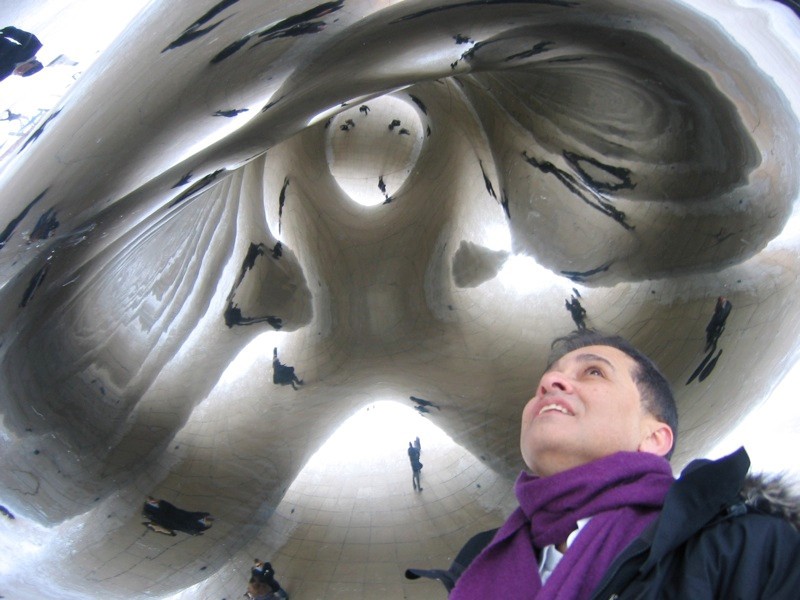
Param Vir visiting Cloud Gate in Chicago
‘While Anish Kapoor’s work has greatly influenced my thinking in recent years, [this] is my first direct creative engagement with it. From the first time that I saw early images of Cloud Gate, his monumental sculpture of stainless-steel set in Chicago’s Millennium Park, I was entranced. What particularly struck me was a sense of timelessness emanating from the work… The simplicity of the work is immediate but deceptive and seems to be inviting us into a symbolic sacred space, a region beyond mere personal expressiveness. As in much of Kapoor’s work, there is a joyfulness and luminosity.’ – Param Vir
It is not only the mythical and ancient (as in works such as Before Krishna (1987)) but contemporary Indian culture which provides a source of inspiration for Vir. His wonderful vast orchestral canvas in Between Earth and Sky (2006), for example, evokes the disorientating beauty of the sculpture of British-Indian artist Anish Kapoor.
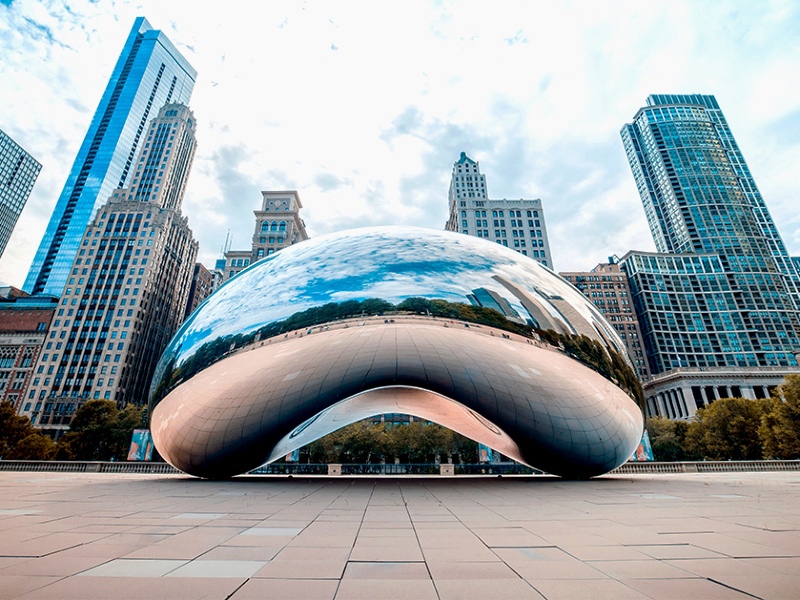
Cloud Gate by Anish Kapoor © Christopher Alvarenga
Naresh Sohal (1938-2018)
Born in Punjab and a long-time resident of the UK, composer Naresh Sohal was a unique voice in contemporary classical music. His work spans two cultures with eloquence and flair. As a British composer, he writes fluently in the Western idiom: as an Asian composer, he draws heavily on the insights of Indian philosophy. He was an adventurous composer, from the use of Indian drums and tabla in chamber and orchestral works, through to an unperformed Concerto for Harmonica, Percussion and Strings (1966). His music has been championed by Sir Andrew Davis, Zubin Mehta and David Atherton.
Concerto for Harmonica, Percussion and Strings (1966)
4perc/2hp.pf[=cel]/man/str(8.6.4.4.2)
15 minutes
Tandava Nritya (Lord Shiva's Dance of Destruction and Recreation) (1984)
3(3pic).3(III:ca).3(III:bcl).3/4.3.3.1/timp.3perc/hp/str
15 minutes
Tandava Nritya is a metaphorical piece. It represents the destruction and recreation of the Universe. In Hindu mythology, this process is enacted by Lord Shiva by his performance of Tandava dance.
The piece is a portrayal of this process in the form of a symbolic story.
A hair-raising work commissioned by the British Council for the LSO Tour of India in 1984 - which, unfortunately did not take place. The piece was first performed in 1993 by the Royal Scottish National Orchestra, conducted by David Davies.
Dhyan 1 (1979)
Cello + 1+afl.1.1.1/1110/3perc/hp.pf/str(8.8.6.6.4)
16 minutes
The BBC Symphony Orchestra-commissioned Dhyan 1 (1979) for cellist Thomas Igloi and is another work worthy of wider performance. It’s ‘an unpretentious, well-made piece with an athletic solo part and pleasing evocations of Indian bands for the orchestra’ (Sunday Telegraph).
Asht Prahar (1965)
Soprano + 3(3pic).3.3(bcl,sx).3/4.3+pictpt.3.1/timp.3perc/2hp.pf.cel/str
25 minutes
A Prahar is a traditional Indian variable unit of time, dividing the day and night each into four prahars. Asht Prahar (Sanskrit for eight Prahars) has eight sections, each representing a prahar. The work is cyclic in form, starting with the dawn chorus and proceeding through the sections without break.
Colour is given its due place in this work, using musical parameters to emphasise the development of time, directly relating the orchestral colour to the colour of the sky throughout the work.
This work was premiered in 1970 by the LPO under Norman del Mar. (The popular Patricia Rosario might relish the challenge of the soprano's intervention here.)
Commissioned for the BBC Proms, The Wanderer, for orchestra, chorus and baritone, premiered to critical acclaim in 1982; and was quickly followed by another work for baritone and orchestra entitled From Gitanjali (1985), premiered in 1985 by John Cheek, Zubin Mehta and the New York Philharmonic Orchestra.
Sohal also frequently set text by the Nobel Laureate, Rabindranath Tagore, the eightieth anniversary of his death was in 2020. Those works include the vocal pieces Poems Of Tagore No.1 (1970) Poems Of Tagore No.2 (1977), Night's Poet (1971), Inscape (1979) and others. He had an inventive ear for texture and colourful instrumentation, expertly distilled when coming to write chamber works such as Hexad (1971) and Octal (1972).
Many of these works were featured on the latest instalment of Heritage Record’s appraisal of Sohal’s work focussing on Instrumental and vocal music which you can purchase here. Explore the newly released series recordings as it stands below for an insight into the range of Sohal’s work.
Kevin Volans (b.1949)
The Village Voice (New York) listed Kevin Volans as "one of the most original and unpredictable voices on the planet”. His catalogue contains music for solo piano to symphony orchestra and everything in between. Many of his works are inspired by India; not least Chakra (2003) ('wheel' in Sanskrit), a name which reflects some moments in this tour de force for 3 percussion. Images with symbolic meaning are a common departure point in Volans’ work. Indeed, in his ninth string quartet Shiva Dances (2004), Volans writes:
‘When Shiva is portrayed dancing (as Nataraj) He is depicted in a circle of flames crushing a small figure - the ego - underfoot. You get the impression He dances on the spot, not moving around at all. I like that.’
Shiva Dances (2004)
String Quartet
24 minutes
Applauding the composer’s accomplishments, The Guardian noted that Shiva Dances ‘reflects Volans' interest in minimal painting and architecture. Its thematic material is pared down almost to a single chord, yet the intensity of expression extracted across 25 minutes is compelling, with the tiniest change of emphasis or inflection assuming massive significance’.
John Tavener (1944-2013)
John Tavener developed a growing interest in Hinduism and Islam which shaped his compositions of the early 2000s. Though he was still an Orthodox Christian, the Universalist belief that all organised religions are simply different interpretations of the same underlying forces has informed most of Tavener’s work of this period and beyond.
Supernatural Songs (2003)
Mezzo sop, pow-wow drum.Hindu temple gong/str(8.8.4.4.3)
30 minutes
Tavener's Supernatural Songs (2003) is one of the earlier examples, a setting of Yeats who himself was deeply influenced by Hinduism and identified himself with the philosophy the Vedantic tradition. Tavener employed a Hindu temple gong and a pow-wow drum to capture the metaphysical and spiritual elements of the text. In Mahashakti (2003), Tavener explored the Hindu concept Shakti – a celestial feminine energy – represented by the solo violin.
Other significant works which explore Universalist and Hindu themes include Hymn of Dawn (2002), Lalishri (2006) and Dhyāna (2007), the latter two being a pair companion pieces written for violinist Nicola Benedetti, exploring feelings of stillness and ecstasy. Requiem Fragments (2013) was one of the last examples of Tavener’s interest in this theme, a work which John Allison of The Times considered the ‘composer’s late masterpiece’.
Tavener’s mystical pantomime Krishna tells the story of the life of lord Krsna through 14 ‘vignettes’ selected from the Bhagarad Gita, Bhagavata Purana and counteless other Hindu mystical poems and texts which tell the story. Krishna receives its world premiere in June 2026 at Grange Park Opera. Each vignette begins with a somewhat ‘improvisatory’ sung-part for the ‘Celestial Narrator’ who will recount the story throughout in English, except for the 13th narration in Sanskrit.
John Cage (1912-1992)
Cage, questioning the view of academics that the purpose of music is communication, required a refreshed intention to keep him composing with belief. The answer he attained came from Indian singer and tabla player Gira Sarabhai, whose philosophy said rather that music’s purpose is “to sober and quiet the mind, thus making it susceptible to divine influences.”
This philosophical influence on Cage was not the only time Indian culture or ideology played a key role in his career. He was also inspired by Indian aesthetics and musical traditions, notably his Solo for Voice #58, an indeterminate set of 18 Microtonal Ragas which utilise Dhrupad style singing.
The Seasons (1947)
2(II:pic).2(II:ca).2(II:bcl).2/2.2.1+btbn.0/timp.3perc/pf(cel).hp/str
OR Solo Piano
15 minutes
Deeply inspired by Indian Philosophy, The Seasons is a sweet, often lyrical 15 minute ballet imitating the natural progression of a year in one act, inspired by the Indian concept of the seasons: Winter as quiescence, Spring as creation, Summer as preservation and Fall as destruction. The work unfolds in nine movements with each season preceded by a Prelude and ending with a Finale. Gramophone has described the work as “Cage at his most poetic, evoking each of the four seasons in lovely changing colours.”
Sonatas and Interludes (1948)
Prepared Piano
Cage’s first composition using Hindu philosophy as a basis, the masterwork for prepared piano (as well as his String Quartet in Four Parts composed a couple of years later) expresses his interpretation of the permanent emotions of the rasa Indian tradition: the Heroic, the Erotic, the Wondrous, the Comic (the four light moods), Sorrow, Fear, Anger, the Odious (the four dark moods), and their common tendency toward (central) Tranquility. Throughout the writing of the work, Cage was engaged often in studying the works of the Indian art historian and critic Ananda K. Coomaraswamy, whose ideologies around the responsibility of the artist to imitate nature in their manner of operation satisfied and validated the composer’s own attitude towards composition and its purpose.
Brian Elias (b. 1948)
Brian Elias was born in Bombay, India, and has lived in the UK since he was thirteen, where he studied at the Royal College of Music and undertook private study with Elisabeth Lutyens. Speaking with Gramophone Magazine in 2019, Elias explains:
‘…despite being in India I was never trained in Indian classical music, something I regret deeply. However I did from infancy hear a wonderful kaleidoscope of sound and music – from the Arabic songs and Hebrew prayers of my Iraqi-Jewish grandparents, to the endless variety of folk music, festivals and prayers of the greatly varied ethnic and religious communities in Bombay, the calls of street vendors, hideously amplified Bollywood songs in every street, the baffling number of languages and dialects spoken everywhere – the list is endless and all these things, more than any formal training I have had, are what I think of as my musical psyche’.
Five Songs to Poems by Irina Ratushinskaya (1989)
4(2pic:2afl).2+ca.2(2Ebcl)+bcl.2+cbn/4.3(Ebflg).2+btbn.1/timp.5perc/2hp.cel/str
28 minutes
Kaleidoscopic layers of sound and music are a hallmark of Elias’ scores, from his debut major orchestral work for the 1984 BBC Proms, L'Eylah, to his British Composer Award-winning works Doubles (2009) and Electra Mourns (2013). Writing about the monumental Five Songs to Poems by Irina Ratushinskaya (1989), Nicholas Kenyon noted that ‘Brian Elias is a composer who writes little but writes well...the new song-cycle is a dazzlingly accomplished piece of writing for voice and orchestra, almost over-extravagant in its opulence.’ (The Observer).
In 1991, Elias collaborated with Kenneth MacMillan on the choreographer’s final ballet The Judas Tree, premiered in 1992 at the Royal Opera House. The dance writer Judith Mackrell wrote: ‘Elias’s fabulous score, strongly textured, moving purposefully through passages of violence and calm, seems to have unleashed MacMillan’s dance imagination…’. A 25-minute suite from the ballet was recently created, titled Betrayal.
Signum Classics released two new portrait albums of works by Elias in 2024, together a retrospective of his chamber music spanning nearly 50 years. Both Music for Strings and Music for Wind feature world-class performances by some of the best interpreters of contemporary music in Britain and abroad, including the Castalian and Sacconi Quartets, Natalie Clein and Nicholas Daniel.
Sakari Oramo and the BBC Symphony Orchestra premiered Elias’ Horn Concerto for Ben Goldscheider at the Aldeburgh Festival in 2025 to excellent reviews. Ivan Hewett wrote, ‘…an enjoyably complex labyrinth in which the music would often turn a corner unexpectedly and give us the same view we saw ten minutes previously, but from a different angle. The soloist Ben Goldscheider was simply astounding…It was extraordinary to hear how many musical personalities the horn could take on… Elias’s new concerto was altogether wonderful...’ (The Telegraph)
![Talisman [Silver amulet belonging to Brian Elias; © Pearce Marchbank RDI]](/media/f3egqdqw/talisman-silver-amulet-belonging-to-brian-elias-pearce-marchbank-rdi-resized.jpg)
Talisman [Silver amulet belonging to Brian Elias; © Pearce Marchbank RDI]