US/UK Customers
 Located in Europe
 Digital download
- Naresh Sohal
The Wanderer (1981)
- Novello & Co Ltd (World)
Commissioned by the BBC for a Promenade Concert in 1982
- 3(2pic)3(ca)3(bcl)3/4431/timp.3perc/2hp.pf[=cel]/str
- SATB
- baritone
- 44 min
- English
Programme Note
In this piece, one of his most successful large-scale works, Sohal adroitly harnesses his fertile orchestral imagination to provide a dramatic reading of an Anglo-Saxon poem that one would normally read as a personal poem. Yet, Sohal’s division of the poem into sections for solo baritone and chorus sounds natural, and the chillingly shrill, eerie tremolos in the strings return from time to time with striking effect in the course of the long, 50-plus minute work. That feature, together with a desolate flute solo that recurs from time to time, provides structural arcs connecting the various stanzas that are distinguished from each other by means of a masterly handling of varied choral-orchestral textures allied to an excellent sense of proportion. While the baritone soloist is assigned the first of the monologues in the poem, the chorus becomes increasingly involved as the work proceeds.
[The composer] was drawn to the poem on account of its “existential bleakness,” to cite the composer’s own words. Additionally, he felt that the poem’s content lent itself to treatment for large musical forces, which brought out the best in him. His ‘bleak’ reading of the poem led him to omit its consolatory Christian ending, a decision that won the approval of Paul Griffiths in his insightful analysis of the piece in The Musical Times:
“No doubt the anonymous author of The Wanderer was not the first to ask what is the point of earthly existence if everything is transitory, unreliable or valueless; certainly he has not been the last. But it is surely not only the hind-sight of a thousand years that makes us see his questions as much stronger than his answers, for the questions have the authenticity of personal experience whereas the answers are those formulated by religious orthodoxy, those of trust in ‘the Father in heaven.’”
While Sohal’s omission of the explicitly Christian content secularises his setting, the composer himself thought that such an omission made the poem tie in with Indian philosophy. Whether one agrees or not with this view, it is quite imaginable that Sohal’s “Indianised” reading of the text gave him the inspiration to set it to music.
Suddhaseel Sen, from cover note from Heritage Records release The Wanderer/Asht Prahar, 2024
Media
Scores
Reviews
Discography
More Info
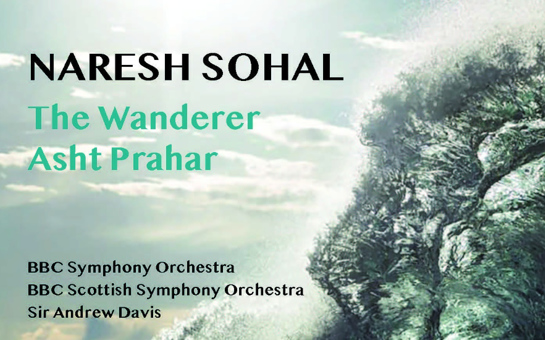
- Naresh Sohal Orchestral works remastered
- 17th January 2025
- Heritage Records release a new CD of remastered recordings of two important orchestra works by Naresh Sohal.