
 Located in the UK
 Located in the USA
 Located in Europe
- Fabián Panisello
Change (2025)
(for Noh voice, baritone, electronics and chamber orchestra)- Henry Litolff’s Verlag GmbH & Co. KG (World)
- Noh Voice (option Contralto voice),bar + fl.ob.cl.perc.e-guit.acc.pno/keyboard - vl.va.vc.db
- Noh Voice (option Contralto voice),bar
- 26 min
- 1st April 2026, Teatro Auditorio "José Luis Perales", Cuenca, Spain
Programme Note
Climate change: the work explores the complex climate situation our planet is facing and the perspective of rapidly approaching a point of no return if decisive changes are not made immediately.
Fabián Panisello developed his new project Change combining synthesis of the essential aspects of the IPCC AR6, the most comprehensive report on climate change, with original Japanese poetry that explores the relationship between humans and nature. This work seeks to highlight the complex current climate situation of the planet.
Through the juxtaposition of these complementary opposite texts, it underscores the risk of reaching a point of no return that would have very dramatic consequences if urgent measures are not taken. The work presents an alternance between two textual levels: IPCC report and Japanese texts selected from waka poems ranging from the 9th to 12th centuries by poets such as Saigyô, Prince Shiki, Ariwara No Narihira, and Ki No Tsurayuki, as well as haikus by Matsuo Bashō, and a Noh text written by Kyōka Izumi in the 20th century. Subtitles or a programme note including the Japanese texts are required, since the Noh voice recites/sings in Japanese.
Textual levels: this confrontation of dramatically different textual levels in their origin and purpose converges on the transcendent relationship between humans and life on the planet from two perspectives that the work proposes as complementary. It seeks to encourage an urgent reflection, from the artistic realm, on the necessity of taking large-scale measures at the present moment.
Semi-staged performance: the baritone (alternating between the roles of a scientist and an activist for climate change) stays in the centre-right while the Noh voice performer (alternating between the roles of a Traditional Noh character and a poetical contemporary Japanese character) sings each of the 11 parts of the piece alongside all 11 players one by one, moving from one to the other and inviting them to play with her. It represents a progressive understanding of the serious information the baritone provides throughout the piece.
Musical elements/text: This work represents research into the language, analysing its temporal structure and syntax, prosody, words, and its manifestations as musical figures such as ‘sounds’, ‘gestures’, ‘melodic and rhythmic cells’, ‘inflections’... In this way, it resumes the composer’s general work with the components of temporal organization such as ‘pulsation’, ‘micropulsation’, ‘irregular pulsation’, ‘patterns’, ‘polymetries’, ‘hoquetus’ and ‘rhythm’.
Musical elements/electronics: This work proposes the use of two sources of material,
1. sounds from nature and 2. Japanese bells, from which the electronics will be developed.
The material will be treated in the studio, avoiding all naturalistic or textual allusions to the sources, although retaining key associative elements such as harmonic spectra – in the case of bells – or patterns of roughness and movement in the case of noise sources and natural sounds.
Among the first category, the following sound natural phenomena will be included: crackling fire, cracking dry ground, the sound of wind, the sound of floods, heavy rain on wet ground, hail, storms, flashes of lightning and dripping permafrost. The samplers of Japanese bells will include bell types such as bonshō and keisu, among others.
More Info
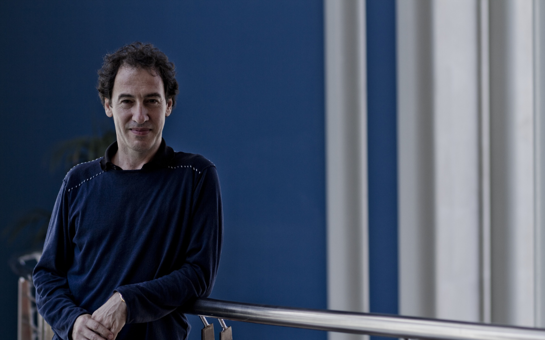
- Plural Ensemble premieres Change by Fabián Panisello at Cuenca Religious Music Week
- 25th March 2026
- As part of the 63rd Cuenca Religious Music Week, Change by Fabián Panisello receives its world premiere by Plural Ensemble on April 1 in Cuenca, Spain.