
 Located in the UK
 Located in the USA
 Located in Europe
- Sally Beamish
Concertante Doubles (2025)
(Double Concerto for Viola, Double Bass and Sinfonietta)- Peters Edition Limited (World)
Commissioned by Swedish Radio Symphony Orchestra
- va,db + 1(pic).1(ca).1(bcl).1(cbn)/1.1.0.0/timp.perc/str (1.1.1.1.1)
- Viola, Double Bass
- 16 min
Programme Note
CONCERTANTE DOUBLES
Sally Beamish 2025
for viola, double bass and sinfonietta
This piece was written for Malin Broman and Rick Stotijn, and is a tribute to their remarkable artistry.
When discussing the new work, the soloists suggested something that related in some way to traditional music, and I decided to take the beautiful song by Robert Burns: Ca’ the Yowes (Call in the Sheep) as a starting point. This love song is set against hills and woodland, with a ‘burnie’ (stream) at its centre.
The scoring is for sinfonietta; with single stringed instruments rather than orchestral ‘sections’, and the interaction between players suggests a large chamber ensemble, rather than an orchestra.
The concerto is a set of variations (or ‘doubles’), each of which references a small part of the original melody. In a series of interactions between the two instruments – messages, conversations, clashes - different aspects of their relationship are explored: sometimes intimate, sometimes angry, sometimes dance-like, sometimes passionate, sometimes wistful. No variation is much longer than two minutes, and each is inspired by words taken from Burns’ poem; words which in turn inspire the soundworld of the scoring.
1. Moonshine Coloured by the glockenspiel, the viola leads the double bass into an exposition of the first few notes of the melody, accompanied by strings.
2. Dance The woodwind and side drum introduce a lively and joyful dance.
3. E’ening Sang (evening song) The soloists call to each other, creating a gentle dialogue. occasionally, bird-like calls are heard – the ‘mavis’, or song-thrush.
4. Ghaist (ghost) For the first time, the soloists state conflicting material; insisting on their own viewpoint, and drawing in support from the ensemble. After an apparent, though uneasy, resolution, the dispute begins again, until calmer woodwinds lead to the next section.
5. Silent Towers Against chorale-like wind chords, and a double bass pizzicato commentary, the viola laments.
6. Water-side Fluid passages rise through the strings to the woodwind, which use darker doublings, (cor anglais and bass clarinet), pointed with light from the glockenspiel. The soloists tussle; reconciling then breaking apart by turns. The ensemble careers towards a climax, from which the soloists emerge, still in disagreement, and eventually taking their dispute into the background as the timpani introduce the next variation.
7. Clay-cauld (clay-cold) The timpani rise with glissandi, which the double bass picks up, and passes to cello and bass in the ensemble, while the soloist climbs to a stratosphere of lonely harmonics. The viola responds by reintroducing its previous lament, and in an exchange of themes, the two reach a concluding reconciliation.
8. THEME:Ca’ the Yowes (Call in the sheep) – the opening music returns, but this time the melody is complete, and played in unison by the soloists.
Concertante Doubles was commissioned by the Swedish Radio Symphony Orchestra, and first performed…etc
Sally Beamish 2025
Duration: 18’
Ca' the yowes to the knowes,
Ca' them where the heather grows
Ca' them where the burnie rows,
My bonie dearie.
Hark! the mavis' e'ening sang
Sounding Cluden's woods amang,
Then a-fauldin let us gang,
My bonie dearie.
As I gaed down the water-side,
There I met my shepherd lad:
He row'd me sweetly in his plaid,
And he ca'd me his dearie.
Yonder Cluden's silent towers,
Where at moonshine midnight hours,
O'er the dewy-bending flowers,
Fairies dance sae cheery.
Ghaist nor bogle shalt thou fear;
Thou 'rt to love and Heaven sae dear,
Nocht of ill may come thee near,
My bonie dearie.
While waters wimple to the sea,
While day blinks in the lift sae hie,
Till clay-cauld death sall blin' my e'e,
Ye sall be my dearie.
Fair and lovely as thou art,
Thou hast stown my very heart;
I can die—but canna part,
My bonie dearie.
Robert Burns
Glossary:
Yowes: ewes, sheep
Knowes: hills
Burnie: stream
Rows: flows
Mavis: song-thrush
Row’d: wrapped
Plaid: shawl
Ghaist: ghost
Bogle: hobgoblin
Nocht: nothing
Wimple: swirl
Sall blin’ my e’e: will blind me
Stown: stolen
Canna: cannot
More Info
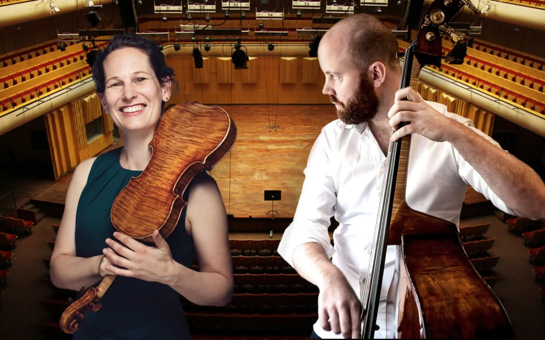
- Beamish Concertante Doubles premieres in Sweden
- 6th February 2026
- Sally Beamish's Concertante Doubles (Double Concerto for Viola, Double Bass and Sinfonietta) premieres in Sweden.