
 Located in the UK
 Located in the USA
 Located in Europe
- George Lewis
...and other spirits (2025)
- C.F. Peters Corporation (World)
Commissioned by the Chicago Center for Contemporary Composition. Premiered by the Grossman Ensemble, conducted by Tim Weiss. Co-commissioned by Birmingham Contemporary Music Group with financial assistance from Arts Council England, Amphion Foundation and the following individuals through BCMG's Sound Investment Scheme: [Names to be inserted] and additional support from the following individuals through BCMG Sound Investment Monthly: Peter Baldwin, John Barnden, Paul Bond, Richard Bratby, Pat Brookfield, Peter Burton, Christopher Carrier, Alan Cook, Dennis Davis, John Glass, Matthew Harris, Stephen Johnson, George Lee, Jeremy Lindon, Seb Lovell-Huckle, Colin Matthews, Paul Mummery, Adam Nagel, Simon & Claire Scott, Howard Skempton, Michael & Sandra Squires, Carolyn & Richard Sugden, Nest Thomas, Janet Upward, Stephen Williams, Blair Winton.
Commissioner exclusivity applies
Unavailable for performance.
- 1.1.1.0.asx/hn/2perc/pf.hp/electronics/2vn.va.vc
- 14 min
- 21st June 2026, CBSO Centre, Birmingham, United Kingdom
- 21st June 2026, CBSO Centre, Birmingham, United Kingdom
Programme Note
Composer note
The title of this work, …and other spirits (German, und anderen Geisten; Latin, et alii extra materiam spiritus), comes from a Latin disputatio by the 18th-century Afro-German philosopher Anton Wilhelm Amo (1703-1759). Indentured as a child and brought to Germany from a region in present-day Ghana, the noble family that Amo served supported him in completing law school training at the University of Halle in 1729. After completing a magister in philosophy from the University of Wittenberg, Amo taught philosophy there, as well as at the universities of Halle and Jena, before returning to Africa in 1747.
I find it fascinating that Amo’s basic intimation in the text below is that God can not be all-powerful because he lacks a living and organic body. Even more intriguing for me is Amo’s explicit reference to “other spirits,” which in the Christianity of his day would be presumed not to even exist. I find this a cryptic reference to his African roots, as well as an implicit challenge to the primacy of European over African metaphysics:
"Although I do not know how God and other spirits beyond matter understand themselves, their operations, and other things, nevertheless, it does not seem likely to me that they understand by means of ideas…For God and other spirits that are posited beyond matter lack sensations, sensory organs, and a living and organic body. …in God there is no knowledge of the past and the future and the absent. Rather, in his cognition all things are present…Therefore it follows from this that God and other spirits understand themselves, their operations, and other things without any ideality or ideas and recollected sensations, whereas our mind both understands and operates through ideas on account of its very tight bond and commerce with the body."
The English translation is from Stephen Menn and Justin E. H. Smith, Anton Wilhelm Amo’s Philosophical Dissertations on Mind and Body (New York: Oxford University Press, 2020). The primary text is Antonius Guilielmus Amo, 1734, “Disputatio philosophica continens ideam distinctam eorum quae competunt vel menti vel corpori nostro vivo et organico” (Philosophical Disputation Containing a Distinct Idea of Those Things That Pertain Either to the Mind or to Our Living and Organic Body). I’d like to thank Menn and Smith for deepening my understanding of Amo’s work and life. I’d also like to acknowledge Dr. Bonaventure Soh Bejeng Ndikung for introducing me to Amo with his establishment of the Anton Wilhelm Amo Center at SAVVY Contemporary Gallery in Berlin.
Many thanks to Augusta Read Thomas, Tim Weiss, Phil Pierick, and the wonderful musicians of the Grossman Ensemble, all of whom have accompanied me on my rather belated and still ongoing journey as a still-emerging composer at the age of 72.
— George Lewis
Composed at the Institute for Ideas and Imagination, Columbia University, Paris Global Center
Media
Reviews
More Info
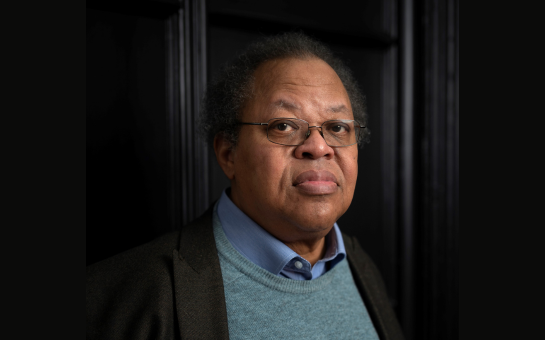
- Edition Peters and George Lewis Enter Long-Term Publishing Relationship
- 10th October 2025
- Edition Peters, part of the Wise Music Group, is pleased to announce a new long-term publishing relationship with composer George Lewis.