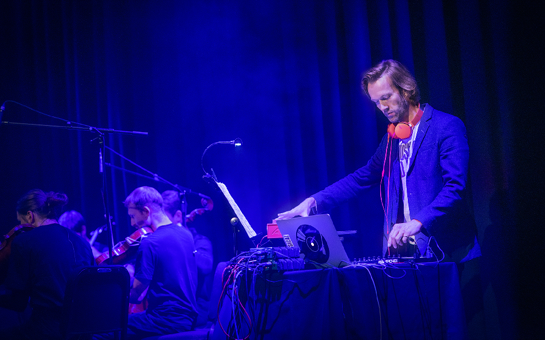
Commissioned by Casa da Música, the Orquestra Sinfónica will perform the world premiere of Gabriel Prokofiev’s Concerto for Synthesizer and Orchestra this Saturday November 15. Pianist Inna Faliks will perform the solo part for Minimoog, with Andrew Gourlay conducting the performance.
The concerto is the first ever composed for a single mono-synth, placed in front of the orchestra in traditional soloist position; dynamically filtering, modulating the sounds of the instrument in real-time as the performance evolves. It features the Minimoog, the godmother of all synths, probably the most influential synthesizer of all time, which kick-started the electronic music revolution when it was first issued in 1970. It has an unrivalled legacy, and its design laid the foundations for the future generations of synthesizers.
Gabriel Prokofiev writes:
Electronic music is all around us, it’s become the soundtrack to contemporary life, but surprisingly there are almost no symphonic concert works that bring together electronic music with orchestra in a dynamic performative way.
With this synthesizer concerto, I think I have found a very exciting solution. Using the right, contemporary synth sounds, played by a virtuoso pianist, a Minimoog synthesizer can be an effective and exciting way to combine live electronic sounds with orchestra.
In my concerto, the synthesizer moves between the sounds of acid house, expressive theremin, complex multiphonics, techno, Drum machine, grimy bass-lines, and beyond. It continually interacts with the orchestra, whose role moves between traditional symphonic, to mimicking the synth, to expressive solos, to DJ-like beats.
As a classical composer, who loves the traditional concerto form, yet also grew up with electronic music (from 80s synth-pop, to 90s rave, to 00s electro), composing this concerto has been one of my most exciting adventures, and the way the Minimoog interacts with orchestra has totally exceeded my expectations.
I feel that this piece captures a particular energy and sound world that is representative of recent and current contemporary culture. Bringing the synthesizer into the orchestra as a solo instrument creates a deep connection with electronic music culture, but in the form of a classical symphonic concerto.