
Our Class of ‘38 Turns 90
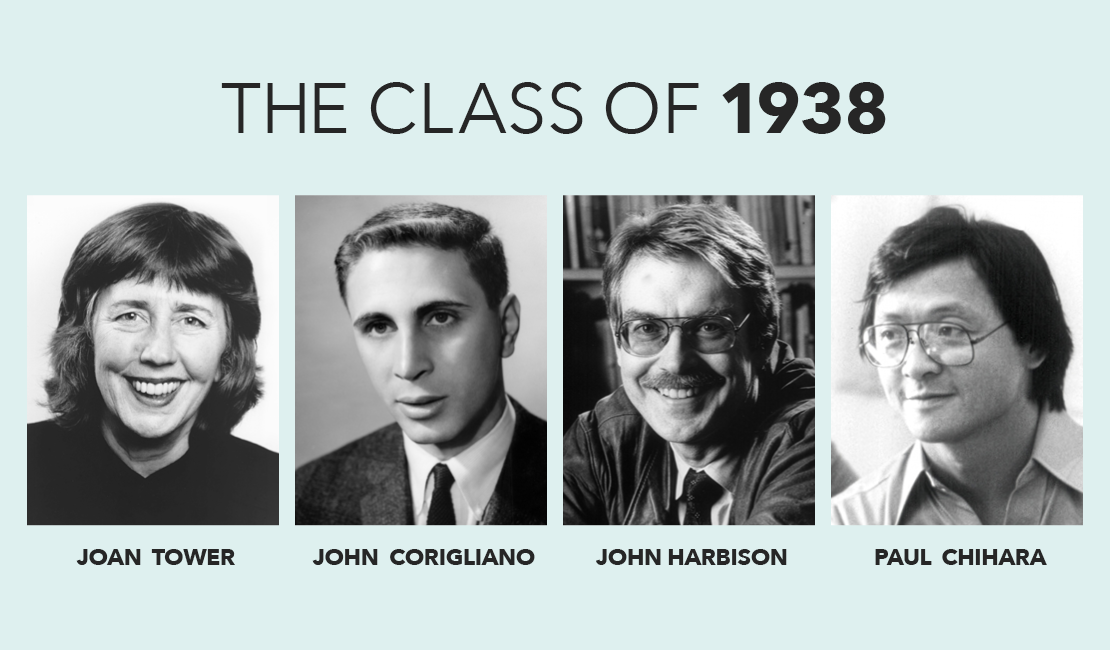
1938 was a big year for American Music. Joan Tower, John Corigliano, John Harbison, and Paul Chihara were all born, forming—alongside Charles Wuorinen, William Bolcom, Gloria Coates, Frederic Rzewski, and others—what has often been called the Class of ’38.
Tower, Corigliano, Harbison, and Chihara have all contributed mightily to the development of contemporary American music through their work as composers, performers, teachers, and advocates. Their lives have intersected with many of the most important streams of modern history, both musical and otherwise. Paul Chihara’s first formative musical experiences were performing in a Japanese-American internment camp in Minidoka, Idaho in which his family was imprisoned for three years during World War II. John Harbison’s encounters with the likes of Igor Stravinsky and Pope John Paul II made him a key conduit between the past and the present. John Corigliano bore tragic but vital witness to the devastation of the AIDS epidemic. And Joan Tower blazed trails for successive generations of female composers with a grace, wit, and steadfast dedication to her musical craft that have both made her work so beloved and her legacy so essential.
All four composers worked in academia, but did so on their own terms (with Chihara even leaving a tenured position at UCLA when he felt it was restraining his creative freedom and expression). Between the four of them are numerous ballets, operas, film scores, concerti, symphonies, and essential chamber works; their combined awards include the Grawemeyer, Pulitzer, Oscar, and GRAMMY, along with several other distinguished honors.
All were deeply influenced by the Western classical music, but these composers also have drawn in a wider constellation of musical styles, including ragtime, tango, minimalism, the Great American Songbook, and more. Above all, each developed their own essential musical voice, their oeuvres full to the brim with expressive and deeply personal works.
To honor of the Class of 1938’s upcoming 90th birthdays, Wise Music is pleased to present a selection of music by these remarkable composers.
__________
Love Returns (2024; 23’) – saxophone and orchestra
Love Returns was commissioned by the Colorado Music Festival, National Symphony Orchestra, Los Angeles Chamber Orchestra, Indianapolis Symphony Orchestra, Aspen Music Festival and School, Toronto Symphony Orchestra, and BBC National Orchestra of Wales and written for saxophonist Steven Banks. The piece is based around a short piano work Love Letter, which Tower dedicated to her late husband Jeff Litfin. Structured as a theme and variations in six sections, Love Returns comes back to the Love Letter theme again in new contexts. As Tower writes, “any relationship is up and down, and you go through various trials and various wonderful periods. This piece is like that. It keeps coming back to this love theme.” The result is a work of “whirling virtuoso passagework countered by aching lyricism,” forming a poignant, expressive, and “uncommonly appealing” musical experience that will speak to anyone who has loved deeply. (The Guardian)
Silver Ladders (1986; 23’) - orchestra
In 1990, Silver Ladders made Joan Tower the first woman to receive the prestigious Grawemeyer Award for Music Composition. The muscular ascending line that forms its core motif displays Tower’s unparalleled command of orchestral tuttis, while its driving ostinatos propel the work forward with strong whiffs of Stravinsky, “supersaturated with color” (The Boston Globe). Lyrical, floating melodic moments for solo instruments (clarinet, oboe, and marimba, among others) provide moments of repose before the climb ever upwards resumes. Silver Ladders is a bold, impeccably-crafted symphonic essay that reflects Tower’s fundamental conviction that great music is “in the risks.”
__________
Symphony No. 1 (1988; 40’) – orchestra
John Corigliano’s first symphony memorializes the many friends that Corigliano lost to the AIDS epidemic, his mourning at their loss, and his anger at the public indifference that led the death toll to be so great. It is a singular work. The symphony is deeply personal, with musical quotations and a “quilt” of interwoven eulogies paying tribute to many departed friends and colleagues. The symphony’s quiet, tender moments are set up by the “blistering wail of orchestral rage” (The New Yorker) that defines its first half. And the epilogue of the fourth movement draws together many of its earlier themes and citations (Leopold Godowsky’s piano transcription of Isaac Albeniz’s "Tango," a tarantella that descends into madness, a duet of solo cellos) into a long, gradual fading away.
Symphony No. 1 is a tentpole of any season and has been conducted by such noted conductors as Gustavo Dudamel, Giancarlo Guerrero, Hannu Lintu, Marin Alsop, and Leonard Slatkin.
Phantasmagoria (Suite from “The Ghosts of Versailles”) (2000; 23’)
Phantasmagoria draws on themes from Corigliano’s groundbreaking opera The Ghosts of Versailles. It recreates much of the opera’s core architecture, opening with “spectral ghost music” that evokes the titular protagonists of the opera, including the playwright Beaumarchais and Marie Antoinette. Melodic fragments from Antoinette’s first aria from the opera lead gradually into a section based around Beaumarchais’ familiar dramatic characters (Figaro, Susanna, etc.), drawing on Figaro’s act I aria and a kind of opera buffa that incorporates subtle quotes of Mozart, Rossini, and Wagner. The piece then brings its many ghosts into the world of the French Revolution through excerpts of the opera’s second act, before echoes of the ghostly harmonics of the opening return to close the work and bring “a satisfying feeling of wholeness and completion” (Classics Today).
A new (2023) version for solo cello and orchestra reworks material from both the orchestral suite and a 1993 piano-cello duo to create a striking concerto-like work that is by turns delicately haunting and incredibly virtuosic. This version was written for cellist Sterling Elliott, a bright cello star of tomorrow with an Avery Fisher Career Grant already under his belt, emblemizing Corigliano’s ability to inspire great musicmaking across the generations.
__________
Diotima (1976; 20’) – orchestra
As WBUR observes, Harbison’s “work is sometimes thorny, angular and rhythmically dense; other times, sweet as the sun. Diotima veers toward the latter mood.” Diotima is a pseudonymous character in Plato’s Symposium who argues that love drives the human search for beauty; Harbison’s engagement with this character was designed in dialogue with a poem by Friedrich Holderlin, who addressed his lover as Diotima. Throughout the piece, intense lyricism is interrupted by periods of stasis—moments of repose and waiting for beauty to return. The result is “cloudy orchestral daydream” and a gorgeous soundscape.
Symphony No. 5 (2007; 25’) – orchestra with baritone and mezzo-soprano soloists
Symphony No. 5 continues Harbison’s long-term interest in the writing of the Polish-American poet Czesław Miłosz. In Symphony No. 5, Milosz’s poetry is set alongside texts by Louise Glück (the “counterforce” to the Milosz section) and Rainier Maria Wilke (a coda-like “summation”). Throughout, the music and text are connected to the myth of Orpheus and Eurydice and with themes of grief and perseverance. Harbison’s varied yet sensitive vocal writing is complemented by a colorful orchestral palette, augmented by the inclusion of an electric guitar. The result is “full of imaginative sounds...but most of all, extremely responsive to the imagery suggested by the poetry at hand.” (The Boston Globe)
__________
The Tempest (1980; 2°) – orchestra
Premiered by San Francisco Ballet in 1980 while Chihara was their composer-in-residence, The Tempest was the company’s first full-length ballet score by an American composer and the Ballet Orchestra’s Grammy-nominated recording debut. The score draws on themes from Henry Purcell’s treatment of the Shakespeare play, but filtered through Chihara’s own distinctive voice. Throughout, Baroque idioms are interwoven with evocations of ragtime, ominous brass rumbles that seem straight out of Chihara’s groundbreaking film scores, and lyrical solo lines. Whether performed with the Michael Smuin choreography or as a concert work, Chihara’s score “offer[s]—to borrow the words of Shakespeare's Caliban—'noises, sounds and sweet airs that give delight and hurt not’” (SFGate).
Concert suites 9 minutes and 50 minutes in length are also available.
Viola Concerto (When Soft Voices Die) (2008; 24’) – viola and orchestra
When Soft Voices Die was commissioned by the Cleveland Orchestra and written for its principal violist, Robert Vernon. The piece had a long gestation; Chihara first began it in 1991, but was forced to set it aside after falling seriously ill. He returned to it almost two decades later, and the piece that was ultimately premiered in 2009 demonstrates a richness and depth that reflects Chihara’s breadth of experience in the intervening years. From “a ruminative, diaphanous opening inspired by Debussy, it climbs to carnivalesque heights in a vast sashaying waltz […] throughout, a swooning melodic fragment keeps reappearing, transformed, in Berlioz-like reminders” (The Plain Dealer).