
Cycles of Light, Ice and Life: Outi Tarkiainen's Orchestral Music
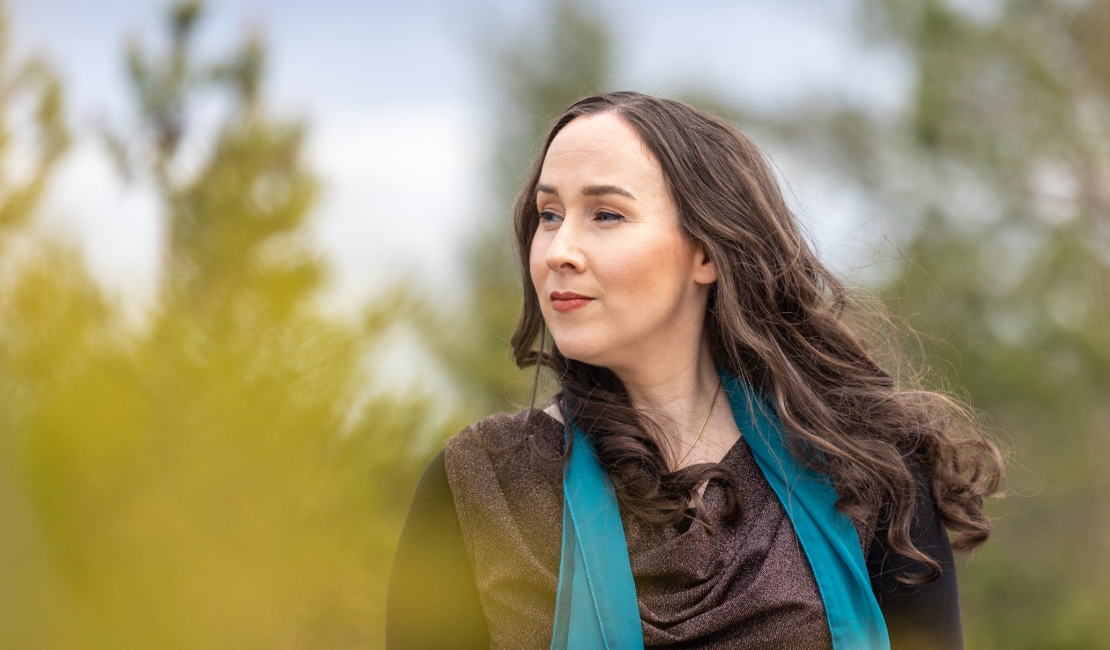
“I see music as a force of nature that can flood over a person and even change entire destinies” – Outi Tarkiainen
With these words, Outi Tarkiainen (b. 1985) articulates a central aspect of her compositional outlook, which can be traced across her orchestral works. Born in Rovaniemi in Finnish Lapland – an area also recognised as part of the traditional homeland of the Sámi people – Tarkiainen’s music is shaped by the region’s vast landscapes and sometimes harsh natural conditions. In several orchestral compositions, Tarkiainen incorporates traditional Sámi folk melodies as a means of paying tribute to Sámi musical traditions.
Over the past decade, Tarkiainen has emerged as one of the most sought-after Nordic composers of her generation, receiving commissions from leading international orchestras and frequent performances on major concert stages worldwide.
Songs of the Ice is an orchestral work about ice in the northern most regions of the world, and how the ice sounds when it ‘breathes’ through the seasons when swelling in the winter and shrinking in the summer. Songs of the Ice was commissioned by the Finnish Radio Symphony Orchestra and Iceland Symphony Orchestra and dedicated to the Okjökull glacier, declared dead in 2014 and Iceland’s first victim of climate change. Thus making the piece a comment on the world’s climate changes.
While Tarkiainen composed the Songs of the Ice, she was expecting her first child, during the heart of winter when the bitter cold strengthens the ice. Tarkiainen said she "was physically reminded of the weeks and months after the birth of our first-born", and that she used "the emptiness and reclosing process that begins in a woman’s body when she parts company with the life inside her in giving birth" when composing it.
Midnight Sun Variations (2019)
Midnight Sun Variations was commissioned by the BBC Philharmonic and the National Arts Centre Orchestra and is dedicated to conductor John Storgårds. The piece explores the light of the Arctic summer night, when the sky north of the Arctic Circle reflects an endless spectrum of colour before gradually receding into the darkness of autumn and winter.
The piece opens with a radiant burst of sound in repeatedly descending motion in the high strings. Solitary woodwind solos emerge above the orchestra, answered by horn calls, before the strings introduce a new beginning. These accumulating waves drive the orchestra forward until the strings break free and ascend, carrying the work towards its culminating gesture.
After its UK premiere Stephen Pritchard from the newspaper Bachtrack wrote that:
Her hugely ambitious score teems with sparkling percussion, while woodwind and strings scurry up and down extended scales, cascades of notes falling over one another as she paints in music the infinitely varying hues of the Arctic summer sky. Bird calls and snatches of melody emerge. All is calm and eerily beautiful on this tonal seascape but underneath there is a relentless forward motion, driving us towards the sun’s zenith, heralded by glissandi trombones and culminating in a shattering climax.
The ring of fire and love (2020)
Tarkiainen’s piece The Ring of Fire and Love (2020) – commissioned by the Royal Stockholm Philharmonic Orchestra – explores the 'ring of fire' which can refer to multiple natural phenomenon’s.
It can refer to the volcanic belt around the Pacific Ocean and the bright ring of sunlight around the moon at the height of a solar eclipse, when the moon covers only the central part of the sun. But it also refers to what a woman feels when, as she gives birth, the baby’s head passes through her pelvis. That moment is the most dangerous in the baby’s life, its little skull being subjected to enormous pressure, preparing it for life in a way unlike any other. In Tarkiainen’s piece, she discovers the earth-shattering, cataclysmic moment a mother and a child travel through together.
After its premiere in October 2020, Susanna Välimäki from the newspaper Helsingin Sanomat wrote:
The fabric of Tarkiainen’s work is the echoing, long-resonating, existential poetry of vast masses. The clear timbres, nature harmonies, spurts and reflections create a floating body of sound. In the final seconds the glittering crystals give way to a bullroarer impression: the wind sweeps over them, not…The end is gripping.
The Rapids of Life was commissioned in 2023 by several of the world’s leading orchestras as an international cultural collaboration. The work is a powerful orchestral depiction of the Ferguson reflex during childbirth, exploring an instinctive and transformative moment in human life.
The piece opens in near silence with a single cello in its highest register, joined by percussion and double basses. Gradually, the full orchestra enters in surging waves of sound that intensify towards a large-scale climax. A sudden stillness follows, from which high strings emerge with long, life-affirming tones, as the music gently recedes in ever-smaller waves.
Tarkiainen has described The Rapids of Life as a work about this paramount moment – an instinctive act of giving birth and the instant when a child first opens its eyes to the world.
While composing the piece, Kaija Saariaho – one of the most significant composers of our time – passed away. As a tribute, Tarkiainen incorporates fragments of Saariaho’s Cello Concerto in the opening cello solo.
Day Night Day – commissioned by the Berliner Philharmoniker and the Finnish Radio Symphony Orchestra – is an orchestral study of the themes from Tarkiainen’s forthcoming opera Day of Night. In Day Night Day Tarkiainen explores the northern lights and the ice that every winter invade the land.
Day Night Day uniquely incorporates references to two Sámi melodies: a yoik of Láve Nigá Risten from the Teno region of Northern Finnish Lapland heralded by muted trumpets towards the beginning of the work, and a variation of the old South Sámi lullaby Sjamma, sjamma hummed at the end by the woodwinds.
After its Finland premiere Hannu-Ilari Lampila from the newspaper Helsingin Sanomat wrote that no Finnish composer can conjure up Lapland landscapes as enchantingly as Outi Tarkiainen. It’s not even worth trying to reach the same level unless, like Tarkiainen, you were born and raised in Lapland and have absorbed its imagery and sensations into your mind and body.