
Operas in Concert: Classics of English Fiction
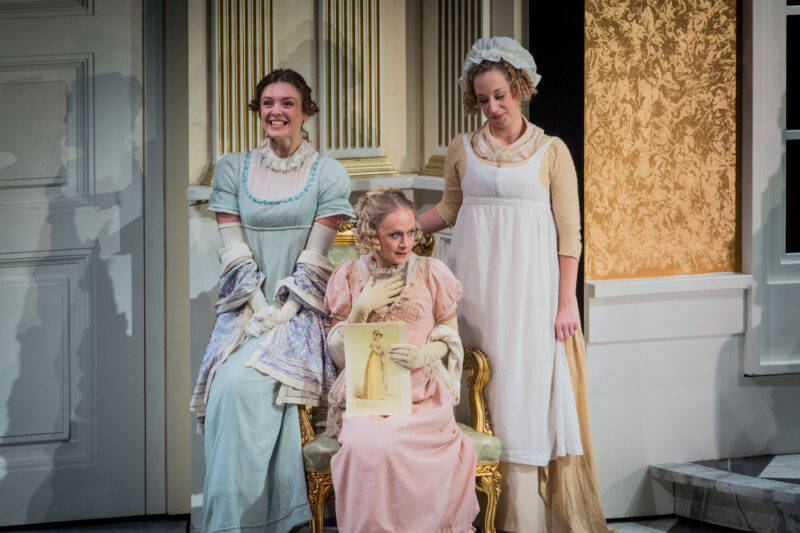
Kirke Mechem / Libretto by the composer after the novel by Jane Austen.
Kirke Mechem’s most recent opera is based on Jane Austen’s beloved novel. Austen’s keen eye for social dynamics (including both the high stakes to find a suitable partner in Regency England and the elements of absurdity in the hunt) finds a worthy match in Mechem’s sensitivity and capacity for humor. Austen aficionado and author of “Austenacious” Liz Ball notes: “It turns out that Austen’s Pride and Prejudice practically begs to be set to music […] Most striking was the way in which the music coordinated with and then illuminated each character in his or her turn—a spot-on aural representation of the people and universe of the novel. Mrs. Bennet as high (not to say shrill) soprano? Check. Darcy as graceful yet manly baritone? Also check. Mr. Collins as hilariously imperious bass baritone? Check check check check. If you think Jane Austen is funny, you’ll think her opera’s funny, too…consider this the Austenacious stamp of approval: we loved what we saw and heard.”
Mechem’s Pride and Prejudice is available for professional company premiere.
Jonathan Dove/Alastair Middleton and Jane Austen
Unlike most operas, Jonathan Dove and Alastair Middleton’s adaptation of Jane Austen’s beloved Regency novel Mansfield Park was never conceived for traditional opera houses. Instead, Dove imagined it for presentation in historic homes with four-hand piano accompaniment; as he observes, “singing around the piano in a drawing-room is an entertainment which Jane Austen would immediately have recognized.” While a newer orchestration for thirteen instruments expands the work’s palette, this version maintains much of the original’s intimacy and an un- or semi-staged version is similarly natural. Musically, Dove “conjures up a remarkable variety of moods, switching from silent movie comedy capers to subtle hints of classical pastiche, as well as minimalist rocking between major and minor at moments of high emotion [… and] some stunning moments of choral singing.” (Bachtrack)
Soloists: Alexandra Jerinic (Fanny Price), Andrew Pardini (Edward Bertram)
excerpt, The Grange Festival
Bernard Herrmann/Lucille Fletcher, based on the first part of the novel by Emily Brontë
As The Guardian observes, “A Wuthering Heights opera by the man who scored Psycho and The Birds is well worth a listen.” Hermann uses the dramatic instincts of his film scoring background to good effect in this substantial opera; Heathcliff’s “opening cry of ‘Cathy!’ sets the chilling tone, with the orchestra’s brooding gusts instantly transporting us to the windswept Yorkshire moors.” Fletcher’s sensitive libretto draws heavily on Brontë’s phrasing, maintaining a palpable sense of the formality and social restrictions of the era. Never performed during Herrmann’s lifetime, this opera has since enjoyed a number of partial and full performances.
Soloists: Layla Claire (Catherine Earnshaw), John Chest (Heathcliff)
excerpt, Minnesota Opera
John Joubert/Kenneth Birkin, based on the novel by Charlotte Brontë
“A score of translucent beauty – Joubert’s undoubted magnum opus,” comments conductor Kenneth Woods who led the English Symphony Orchestra in the premiere performance of Jane Eyre in concert. Joubert's final opera, this bold adaptation of Charlotte Brontë's novel is now to be performed fully staged for the first time in August 2025 by Grimeborn Opera, where Jane’s journey unfolds through a dynamic cast of young performers directed by Eleanor Burke. The story follows one woman’s fight for freedom and fulfilment on her own terms, facing adversity, injustice, and a shattering betrayal.
Art’s Afterlives | Feminist Essays | Casting Off Chains: Abolition and the Civil War | The Americas: Latine Culture and History | East Asian Love Stories | Positively Medieval: Stories of the Middle Ages and Renaissance | Classics of English Fiction | The 19th Century: Great Wars and Colonial Sorrows | Upheavals of the 20th Century | The Weight of Motherhood