
Tōru Takemitsu
Summary
As a young man in Japan’s Chinese colony of Manchuria, Tōru Takemitsu was drafted into a labor gang to construct Japanese army camps as a young teenager during World War II. His personal reaction to the war-time climate of Japanese imperialism was a hatred of his country and its culture. He avidly consumed the music of American composers such as Copland, Sessions, and Piston, then later Berg, Webern, Debussy, and Messiaen as he worked for the U.S. Armed Forces and taught himself to compose after the war. He remained largely self-taught throughout his life, eschewing both higher-level formal training and any teaching position. By his 20s, his works were being broadly performed, and he had co-founded the multimedia artistic group Jikken Kōbō, which was heavily influenced by the Western avant-garde. A chance encounter with Stravinsky in 1958 brought him a Koussevitsky commission, which later premiered under Copland’s baton in the US and helped him build his position as an internationally recognized composer heard across concert halls and in a number of film scores.
Performances
Features
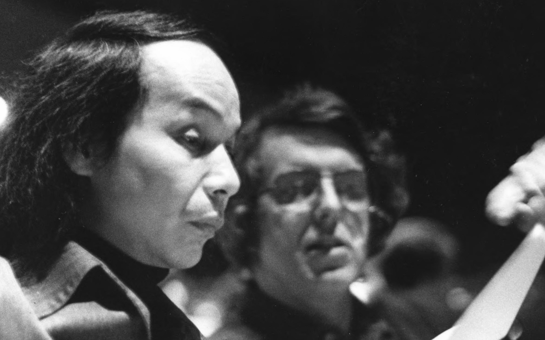
- Takemitsu at 100: “an ocean that has no west and no east”
- A brief guide to our small but vital catalogue of symphonic works by this iconic Japanese composer.

- Curtain-Up | Concert Openers
- Explore engaging, creative, and captivating orchestral openers for your upcoming programs. Set the stage for memorable musical experiences after the curtain comes up.