

 US/UK Customers
 Located in Europe
 Digital download
- Matthew Aucoin
Two Thresholds (Symphony) (2026)
- Associated Music Publishers Inc (World)
Commissioned by The Aspen Music Festival and School, Robert Spano, Music Director; the Dortmund Philharmoniker; and the Lakes Area Music Festival, with the generous support of Mike and Margo Oberman
Unavailable for performance.
- S,Mz + 3(III:pic,afl).2+ca.2+bcl.2+cbn/4.3.2+btbn.1/timp.3perc/pf.hp/str
- Soprano, Mezzo-soprano
- 35 min
- Jorie Graham
Programme Note
Composer's Note
Two Thresholds (Symphony) takes an unusual form: the work begins with a near-miss with death, and ends with a memory, from early childhood, of a first emergence into consciousness, amazement, and wonder at the world.
Though this symphonic work is mostly instrumental, is bookended by settings of two Jorie Graham poems. In a way, it is a sequel to my music-theater piece Music for New Bodies (2024), which also set a series of poems by Jorie Graham. That earlier work was based on poems that reckon with multiple crises of the contemporary world, among them runaway technological development and runaway climate change. In this new piece, I wanted to strike a more personal tone. Whereas Music for New Bodies is spoken by a kind of collective consciousness, Two Thresholds is spoken by an individual, and it gives voice to mainly personal and individual crises, epiphanies, and experiences of joy. And whereas the instrumental sections of Music for New Bodies are relatively brief, in Two Thresholds the proportions are reversed: the vocal sections are relatively brief, and the most elaborate development takes place in the instrumental sections.
The piece’s initial encounter with death opens out into a wild, ever-metamorphosing orchestral section, a kind of writhing dance to ward off death’s approach. This section culminates in a kind of abyss, a black hole of descending intervals, out of which it seems almost impossible to escape. But finally a searching oboe line does emerge, seeming to guide the ensemble back into the light. The singer returns, with a new perspective on her near-miss: now she is overwhelmed by gratitude to be alive.
This sense of gratitude spills into the instrumental second movement, which bubbles over with joy and relief.
In the third movement, through the haze of time, a memory emerges of the other “threshold”: not death but birth, awakening, and emergence. The speaker remembers a moment when she was separated from her mother as a toddler, and in that brief experience of solitude, she experienced the world for the first time before being found once again. In that almost blinding experience of “appearance and disappearance / in my only life,” the pieces surges to its conclusion.
— Matthew Aucoin
Movements
I. Death [flashed her brights at me] – Mezzo-soprano
II.
III. Cagnes-sur-Mer 1950 – Soprano, Mezzo-soprano
Scores
More Info
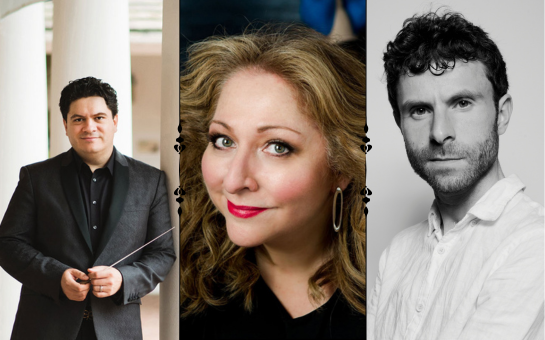
- Măcelaru, Goerke, Aspen debut Matthew Aucoin's Symphony
- 16th July 2026
- July 19th marks the highly anticipated world premiere of Two Thresholds, a new vocal symphony by composer Matthew Aucoin.