

 US/UK Customers
 Located in Europe
 Digital download
- Britta Byström
Seen from Above (2026)
( Concerto for Orchestra)- Edition Wilhelm Hansen Copenhagen (World)
Commissioned by the Royal Stockholm Philharmonic Orchestra
Commissioner exclusivity applies
Programme Note
”It’s gratifying that I can always wake up before dying”
This short stanza from In Praise of Dreams by Wisława Szymborska led me into the composition of Seen From Above. Once again, I found myself returning to the world of Szymborska, having previously set music to her poems Possibilities and, in fact, In Praise of Dreams. This time, however, her poetry provided the inspiration for music without words – a concerto for orchestra.
Seen From Above consists of six movements. Both the piece as a whole and the individual movements take their names from a Szymborska poem. The music is not intended as an illustration, but is rather a form of free association, using the poems as a springboard. Szymborska’s poetry is written with a light touch – often subtle, always precise, never obscure. We are often lured in by a seemingly carefree opening before unexpected depths reveal themselves.
A ‘concert for orchestra’ is a concert in which the orchestra is the soloist. In this work, this becomes evident in that the music is based on polyphonic patterns rather than on timbre. Many little voices – often in different types of canon – join together to create a musical mosaic. Hence the title of the work: Seen From Above refers to taking a step back, as it were, and viewing the orchestra from a distance – as when one wishes to make out the motif in a pointillist painting.
The work contains several references: In Movement V, “Psalm”, I have quoted Es ist ein Ros entsprungen which in addition to its beautiful melody, also has the characteristic of being cyclical. Here we find the clearest example of the canon: a six-part canon runs throughout the movement with each part consisting of two voices. In Movement IV, short themes from my earlier Szymborska works are woven into the pattern.
As a sort of musical DNA, the work also includes the Danish composer Per Nørgård’s infinity series, here mostly chosen in its simplest and most fundamental form, the two-note series – a method for creating infinite patterns based on just two notes, one light and one dark. This method felt somehow connected to Szymborska’s world, also ranging from the very simple to the very complex. As a composer, it can feel like juggling more and more balls… And it is gratifying that one can always wake up before everything comes crashing down.
- Britta Byström, 2026
Swedish version
”Och lyckligtvis kan jag alltid vakna strax innan jag dör.”
Denna lilla Szymborska-strof, ur dikten Lovsång till drömmarna, ledde mig in i komponerandet av Seen From Above. Jag kom därmed att återvända till Wisława Szymborskas värld, efter att tidigare ha tonsatt dikterna Möjligheter och just Lovsång till drömmarna. Men den här gången fick hennes poesi ge inspiration till musik utan text – en konsert för orkester.
Seen From Above består av sex satser. Både verket som helhet och de enskilda satserna har lånat sitt namn från en Szymborska-dikt. Musiken är inte tänkt som en illustration, utan är mer en sorts fria associationer med dikterna som språngbräda. Szymborskas poesi är skriven med lätt hand – ofta underfundig, alltid precis, aldrig dunkel. Många gånger lockas vi in i dikten genom en obekymrad början, där sedan oväntade bråddjup öppnar sig.
En ‘konsert för orkester’ är en konsert där orkestern är solist. Här märks detta genom att musiken bygger på mångstämmiga mönster snarare än på klang. Många små röster – ofta i olika typer av kanonformer – skapar tillsammans en musikalisk mosaik. Härav verkets titel: Seen From Above syftar på att man liksom tar ett steg tillbaka och betraktar orkestern på håll – som när man vill urskilja motivet i en pointillistisk målning.
I verket finns några citat: I sats V, ”Psalm”, har jag citerat Det är en ros utsprungen (psalm nr 113), som utöver sin vackra melodi också har den egenskapen att den går i cirkel. Här finns det allra tydligaste kanonexemplet: Genom hela satsen löper en sexstämmig kanon, där varje stämma består av två röster. I sats IV finns små teman från min tidigare Szymborska-musik invävda i mönstret.
Som ett slags musikalisk DNA i verket finns också den danske tonsättaren Per Nørgårds oändlighetsserie, här mestadels använd i sin allra enklaste och mest grundläggande form, tvåtonsserien – en metod för att skapa oändliga mönster utifrån endast två toner, en ljus och en mörk. Denna metod kändes på något sätt besläktad med Szymborskas värld, eftersom den också har en spännvidd från det mycket enkla till det mycket komplicerade. Som tonsättare kan det kännas som att jonglera med allt fler och fler bollar… Och lyckligtvis kan man alltid vakna strax innan allt faller samman.
- Britta Byström, 2026
Reviews
More Info
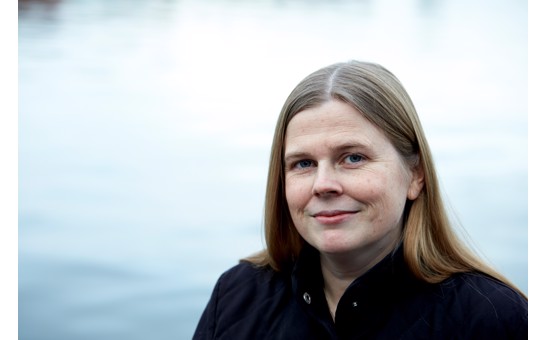
- World Premiere of 'Seen from Above' by Britta Byström
- 30th September 2026
- Royal Stockholm Philharmonic Orchestra and Ryan Bancroft present Byström's latest orchestral work this October.