Located in the UK
 Located in the USA
 Located in Europe
- Bernard Herrmann
On Dangerous Ground: Suite (1951)
- EMI Music Inc (World)
ed. Christopher Husted
- 3(3pic).2+ca.2+bcl.2+cbn/8.3.3.1/timp.2perc/pf.hp/str; Viola d'amore solo in mvts II and IV
- 15 min 30 s
Programme Note
Movements
1. Prelude
2. Blindness
3. The Death Hunt and The Hunt's End
4. Parting and Return
5. Finale
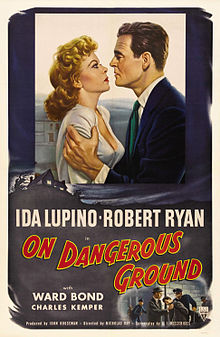
On Dangerous Ground was, for many years, a little-known detective film; now it enjoys a respectable reputation among enthusiasts of film noir. Released in 1951, it was produced by John Houseman (later famous for his role as the professor in The Paper Chase) and directed by Nicholas Ray (best known as director of Rebel Without a Cause). Based on a novel by mystery writer Gerald Butler called Mad with Much Heart, Ray's film expanded upon Butler's novel to create a story in two halves. The first part is set in the darkest reaches of the inner city, where detective Jim Wilson (Robert Ryan) is losing his edge. Seething with anger over the recent murder of one of his fellow policemen, he preys upon the suspects he encounters in his work with steadily increasing brutality. In an effort to "cool him off," the police department loans him to a rural force struggling to track a man who has recently raped and murdered a young girl. The assignment takes him into the film's second part, set in the brilliant light of the upstate rural winterscape. He arrives to find the girl's father Brent (Ward Bond) nearly insane with rage — and intent on being the first to find the culprit so he can kill him himself. Ironically, a critical challenge for Wilson in managing the investigation is that he must restrain Brent from behaving exactly as he does! This part of the film focuses on the steadily narrowing chase, its tragic outcome, and a hopeful new beginning for Wilson that results from the experience.
The offer to score the film came soon after one of Herrmann's greatest career disappointments. After seven productive years as principal conductor of the CBS Symphony Orchestra, Herrmann looked on helplessly as the aggressive post-war effort to make television a viable industry finally moved the network to disband its house orchestra. The loss would effectively end Herrmann's career as a composer of concert music, driving him to Hollywood to score films while he searched for a way to revive his conducting career. Though fate would see to it that he was bitterly disappointed in that ambition, posterity won in the bargain a number of the most highly regarded film scores ever written.
The commission to score On Dangerous Ground found Herrmann at the height of his powers: in spite of (or perhaps because of?!) his painful and infuriating misfortune with the CBS Symphony, he spent the last 40 days of 1950 composing one of his most impressive orchestral scores. It is especially noted for several novel touches of orchestration: the most violent moments are accented by the addition of a steel plate to the percussion section; the most sensuous moments — associated with the heroine Mary Malden (Ida Lupino) — feature lyrical solos for the viola d'amore, whose delicate sound was at its greatest favor during the Baroque era. Equally as striking is the brief, but furious, addition of four extra horns during the climactic scene of the film.
The present suite presents music from five important sequences, exactly as they were written for the film. The first, "Prelude," accompanies the credits, and introduces the music that evokes Wilson's violent outbursts. Though Herrmann's vocabulary of chords is very simple, they are applied to the orchestra deftly to create striking gestures. Brief fragments of melody provide points of departure, acting like battle cries before the tumbling, parrying chords resume. After several alternations a short, somber coda terminates the troubled mood without resolving it.
The music from the second sequence stands in stark contrast to the first. When Wilson arrives upstate, he barely has time to question Brent's family before the posse sights the suspect and sets out immediately to chase him. Brent and Wilson eventually break away from the others in the pursuit, which moves from foot to wheel when the suspect steals a car. They are led to a remote farmhouse where they find only a young woman, Mary Malden. Her air of solitude and calm is immediately apparent — more so than her blindness, which Wilson recognizes in due course. Titled "Blindness," this music presents two important themes characterizing Mary, both scored for the viola d'amore. The first, heard at the outset, captures her sensitivity and calm: though put through a suddenly agitated variation, the calm is quickly restored when the viola returns. The mood is developed at length, eventually giving way to growing tension and menace as she grows confused by the dim light she senses: Wilson is waiving a match before her eyes, testing her ability to see it. The viola d'amore then takes up the second theme, which evokes Mary's fearful apprehension. After an unsuccessful attempt to secretly explain to Brent Mary's blindness, Wilson goes upstairs to search the rooms while Brent angrily explains what has happened and demands to know what she knows about the assailant. The music reaches a brief climax of grieving feeling as Mary reacts with tears to the story of Brent's daughter's death, realizing fully what it means. The opening theme returns as a brief coda, closing the sequence.
While Brent searches the grounds of the farm, Wilson slyly attempts to question Mary into a confession of her obvious relationship to the assailant. In short order Wilson finds himself questioned by Mary, who proves to be no slouch at manipulative interrogation. The assailant is Danny, her younger brother: he is mentally unstable, and they live in dependence upon one another. She manages to strike a deal with Wilson to wait until the morning so Mary can convince Danny to give himself up.
The plan soon goes awry at dawn; Mary fails to convince Danny, who flees into the foothills. Wilson is soon to follow, trailing him to a small cabin near a range of steep cliffs. Wilson nearly succeeds in talking Danny into compliance when Brent bursts upon the scene, spurring a desperate chase into the treacherous, snow-bound mountainside. Herrmann rouses for the chase as well in this third sequence, entitled "The Death Hunt." Among the greatest tours de force of Hollywood film music, it concentrates many of the ideas developed in the course of the score, and is as dazzlingly virtuosic as it is ferocious. The pace is breathless, pitting eight horns, baying like dogs with "hunting horn" figures in triplets, against an orchestra that responds in kind. After an extended and insistent fray, the pace slackens only in a short series of pauses — each broken quickly by maniacal fanfares for the horns — as Wilson and Brent close the last distance on their prey. Desperate, trapped at an impassable cliff, the killer begins to lose his balance and cries out in terror as fate robs his pursuers of satisfaction in their chase.
After a pause, "The Hunt's End" captures the stunned and sobered reaction of Wilson and Brent as they realize the chase is, at last, over. Herrmann makes deft use of the varied timbres of muted brass, which are accented by a brilliant touch: rapidly turning arpeggio figures for bass clarinet, bassoons, and contrabassoon. The mood is at once mournful and viscerally violent: Brent — at last freed from his tormenting rage — finds the killer is only in his late teens: "He just…a kid…. That's all he is…just…a kid!" His bloodlust of only moments before at last purged, Brent's grief for the loss of his daughter follows immediately in its train, taking Danny as its new object. Brent insists on carrying the body back down the mountain himself.
Mary is devastated by Danny's death; Wilson is deeply moved by her somber resolve in the face of being alone and vulnerable with her handicap. He walks her home: once there he cautiously questions her about how she will go on alone. The conversation steadily escalates into an argument; she tries to walk out of the room in anger, only to fall as the familiar arrangement of furniture is disturbed in her desperate movement. In "Parting and Return," Herrmann seizes upon her collapse to the floor with a sad gesture for bassoons and the sections of violins; it is followed immediately by the viola d'amore, which takes up Mary's second theme as Mary tearfully vents her grief and agitation. Wilson relents, telling her he'll return to the city to resume his work with the police there. He pauses before leaving to restore the furniture to its familiar arrangement, walking out in silence: as the door closes, Mary feels brave enough to say "thank you" for his sensitive gesture to her dignity — which she's observed in him before.
The clarinets and sections of violins take up a long melody in parallel thirds as Wilson walks to Brent's truck. Their exchange is brief when Brent asks about Mary; the viola d'amore returns as she is mentioned, now commenting on Wilson's vulnerability as he stolidly surveys the snow and ice.
Only a short time after resuming his duties in the city he violently batters a suspect in a chase; haunted by the quiet grace — and aware that he too is vulnerable — he resolves to return to her. Herm1ann's "Finale" begins with the dawning of Wilson's resolve to leave the dead-end of the city. The cor anglais presents a variant on Mary's second theme, this time suggesting mastery over the fear it represents. A lyrical melody, expressed in parallel thirds by the sections of violins, follows as Wilson drives into the countryside once again; it is passed to the clarinets as Wilson arrives at Mary's house, modulating through several keys as he is going inside and sees Mary on the stairs. Her first theme is taken up by the strings, first in songful lyricism, and then in a jubilant carillon as their embrace suggests their newfound path out of lonely isolation.
— Christopher Husted