US/UK Customers

 Located in Europe

 Digital download

- Fabien Lévy
Que reste-t-il? – Hindewhu extinction – (2026)
(for orchestra)- Henry Litolff’s Verlag GmbH & Co. KG (World)
- 3(II:pic).3(III:ca).2(cbcl)+bcl.2+cbn/4.3.2+btbn.1/timp.4perc/grndpno(epf)/acn/str(14.12/10/8/6)
- 16 min
Programme Note
The music of the Mbaka, Bedzan, and Aka peoples of Central Africa has been a part of my life since I began studying ethnomusicology and visited the Bedzan in the Tikar region of Cameroon in 2000. They have taught me a great deal, both from a technical perspective (polyrhythms, shifts in voice as a means of creating confusion, the unique treatment of repetition and ornamentation) and in terms of sociological and philosophical principles: the unique relationship between the individual and the group, between the musician and his or her instrument, the constant misdirections aimed at deconstructing any autonomous unit, and so on.
Hindewhu is the name of an extremely simple flute played by the Ba-MBenzele. The instrument consists of a small tube about ten centimeters long, made from a papaya branch, which has no tone holes. As a result, it produces only a single note. In a broader sense, Hindewhu refers to a repertoire for solo voice sung in the hoquetus style to accompany this single-note flute. The compositional possibilities seem limited due to the monodic constraints of the soloist, who sings in the hoquetus accompanied by this single-note flute. In my opinion, however, the Hindewhu compositions rank among the most subtle repertoires known to humanity. From an instrumental perspective, this repertoire – like any Pygmy repertoire – exhibits wonderful ambivalences between the part and the whole: a singing voice that often employs yodeling techniques, so that the uniqueness of the musician is perceptually split into at least three virtual sound entities – namely, the two vocal registers and the unique sound of the flute.
However, the deconstruction of the units' autonomy does not end there, as the ethnomusicologist (and one of my mentors) Simha Arom has shown in an outstanding analysis of this repertoire (1): In most Hindewhu pieces, the voice sings "asymmetrical" formulas [3+2+2]+[3+2], that is, 12 elementary units (asymmetric half-periods [7]+[5]), which are repeated three times within a total period of 12 ternary measures, as is commonly done with virtuosity in most Central African repertoires(2). This simple flute produces a single note, played at regular intervals throughout all four basic measures. It fits into the pauses of these complex asymmetrical vocal phrases as a perfect hocket. Here one marvels at the mathematical virtuosity of these compositions, achieved despite the use of extremely simple means. Just try calculating that mathematically! And one marvels at the beauty of these different timbres.
The entire performance takes place outdoors – a masterpiece of composition/decomposition, presented by musicians who do not articulate music theory in words and do not fetishize complex instruments (due to their nomadic lifestyle, their rudimentary tools, and their indifference to technological advancement, unlike the sedentary populations in their vicinity or other sedentary civilizations worldwide, including our own), who do not attend music school, have no concept of musical professionalization or soloism, and live in close harmony with nature. A thought-provoking contrast to our orchestras, our musical notation, our logocentrism, the music of our highly professional artists, and our contempt for other cultures and our planet. This repertoire, however, is little known, and these peoples are disappearing due to the climate crisis – for which they are not responsible, but we are.
My composition is not a Hindewhu. It makes no claim to folklore or any other form of cultural appropriation. Its purpose is different – multifaceted – and above all, a commentary on our crisis-ridden times. Numerous techniques – in particular my usual personal polyrhythmic techniques, paradoxical sound textures, and acoustic illusions – reflect my current state of mind, which is shaken by these times and by our selfishness. Yet, in the background, my composition is also an indirect and symbolic homage to this repertoire and to those peoples from whom I have learned so much. The piece also serves as a framework for this instrument and this musical mindset. It is an invitation to become more familiar with this magnificent repertoire, as well as a sad and disillusioned allegory of our times and the state of our planet.
(1) Arom, Simha (1998), «‹The Tree That Hid the Forest›: Metrical and Rhythmic Principles in the Central African Republic», Revue belge de Musicologie/Belgisch Tijdschrift voor Muziekwetenschap, vol. 52, pp. 179–195.
(2) Arom, Simha (1985), Instrumental Polyphonies and Polyrhythms of Central Africa, Paris, SELAF Verlag.
Media
More Info
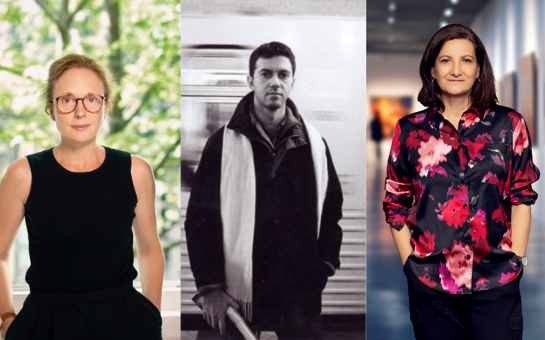
- World premieres and honor ceremony at Donaueschinger Musiktage
- 9th October 2026
- This year’s Donaueschinger Musiktage presents the world premieres of works by Rebecca Saunders and Fabien Lévy as well as the German Composers Association’s ceremony where a badge of honor will be awarded to Charlotte Seither.