
Betsy Jolas at 100
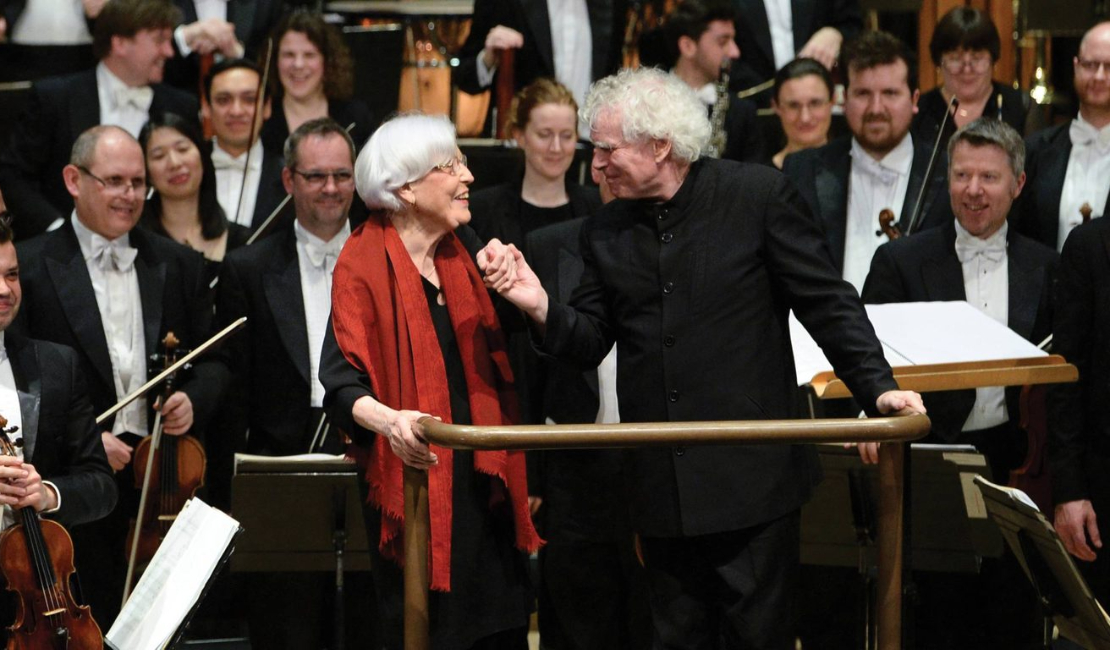
“Betsy Jolas – one of the most extraordinary living composers. She’s lived through everything. She is funny and wise and imaginative and slightly off the wall, and so is her music.”
Sir Simon Rattle on Betsy Jolas
Betsy Jolas was born nearly a century ago in August 1926. She is an important globally recognised figure in the world of 20th and 21st century music.
At the heart of her aesthetic is the voice, which occupies a very important place in her work, whether sung by a human performer or faithfully evoked and represented by instruments.
Jolas was a student of two key figures in music – Olivier Messiaen and Darius Milhaud –from them she inherited a rich French musical tradition, despite her character and personal influences, which would forge her own sound universe. Her true modernity is not the result of a radical break with tradition, but rather of the sophisticated dialogue she maintains between the various techniques of ancient polyphony and the infinite possibilities of the contemporary movement. Her compositions, ranging from intimate chamber pieces to large-scale lyrical and orchestral works, continue to be commissioned by the world's greatest concert halls, from the Philharmonie de Paris to Lincoln Center and Tanglewood, to name but a few.
To celebrate Betsy Jolas' centenary, Alphonse Leduc and Wise Music Group are pleased to select some key works for your programming:
A Little Summer Suite (2015)
for symphony orchestra
Commissioned by the Berliner Philharmoniker and dedicated to Sir Simon Rattle, A Little Summer Suite is an orchestral celebration capturing a very radiant style. Thanks to its playful architecture, this suite is a testament to her enduring ability to redefine the modern orchestra, adding her free lyricism to it.
Quatuor II (1964)
for coloratura soprano and string trio
The coloratura soprano part in this work is renowned for its unique character, as it is composed entirely of non-semantic phonemes, with the voice treated as an instrumental timbre rather than a vehicle for lyrics and text. This piece marked Betsy Jolas' debut in her unique approach to vocal writing.
J.D.E. (1966)
for chamber orchestra
An emblematic work from her post-serial period, this composition for an ensemble of 14 instruments greatly contributed to expanding her reputation among contemporary music ensembles. This piece is characteristic of Jolas' style through its use of instrumental colours.
4 plages (1967)
for string orchestra
This work was written exclusively for a large ensemble of 24 string players, exploring the massive timbral potential of strings, as well as the multitude of choices that such a formation can offer. Above all, it is famous for its rich sound textures and the doubling produced by the massed strings.
B for Sonata (1973)
for Solo Piano
Written for Marie-Françoise Bucquet, this major solo work explores the percussive and resonant capabilities of the piano. The title is an enigmatic reference to ‘B for Bali’, the music being characterised by long non-tonal convolutions rising in intensity to the climax of the work.
Le Pavillon au Bord de la Rivière (1975)
Chamber Opera in Four Acts
Composed for the Avignon Festival, this chamber opera is inspired by a 13th-century Chinese play written by Kuan Han-Chin. This evocative four-act work highlights Jolas' sensitivity, with a score for a vocal quartet and an eight-piece chamber ensemble. Through contemporary vocal techniques attuned to her instrumental lyricism, Jolas creates a bridge between ancient dramatic structures and modern sound, emphasising the timeless nature of emotions.
“Jolas is credited with achieving the extraordinary synthesis of a profoundly intellectual music and a lyrical fervor that distinguishes her from her contemporaries.”
Paul Griffiths, New York Times